
At a Glance
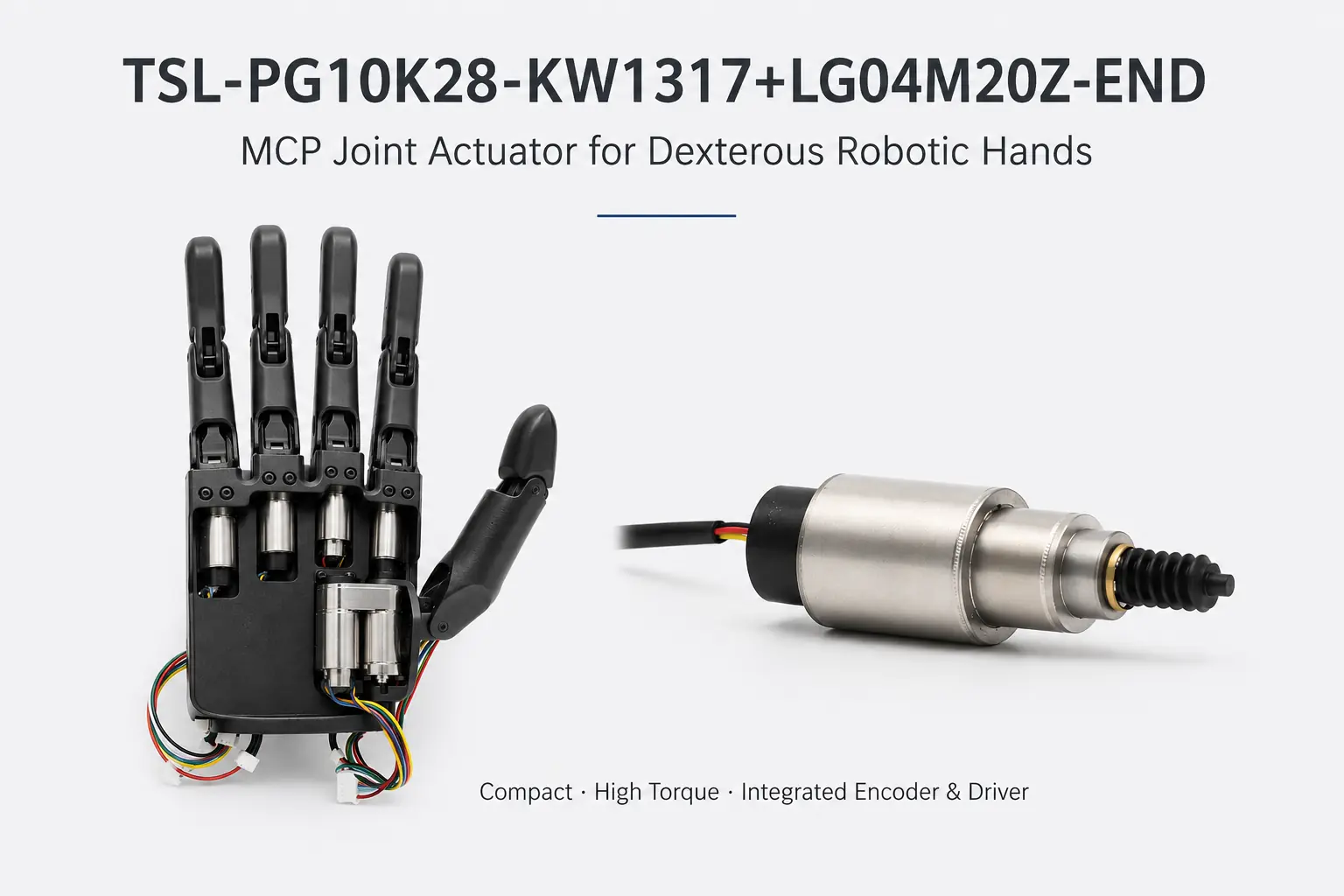
The TSL-PG10K28-KW1317+LG04M20Z-END is a compact integrated actuator designed for MCP joints in dexterous robotic hands. Combining a coreless brushless motor, planetary gearbox, worm gear transmission, encoder, and driver in one module, it provides reliable torque output, closed-loop position control, and simplified system integration within limited palm space.
As one of the most important end-effectors through which robots interact directly with the external environment, a dexterous robotic hand must not only be capable of grasping objects, but also provide good motion coordination, accurate position control, and stable continuous-load performance.
In a multi-finger dexterous hand, the MCP joint, or metacarpophalangeal joint, is the main connection between the palm and each finger.
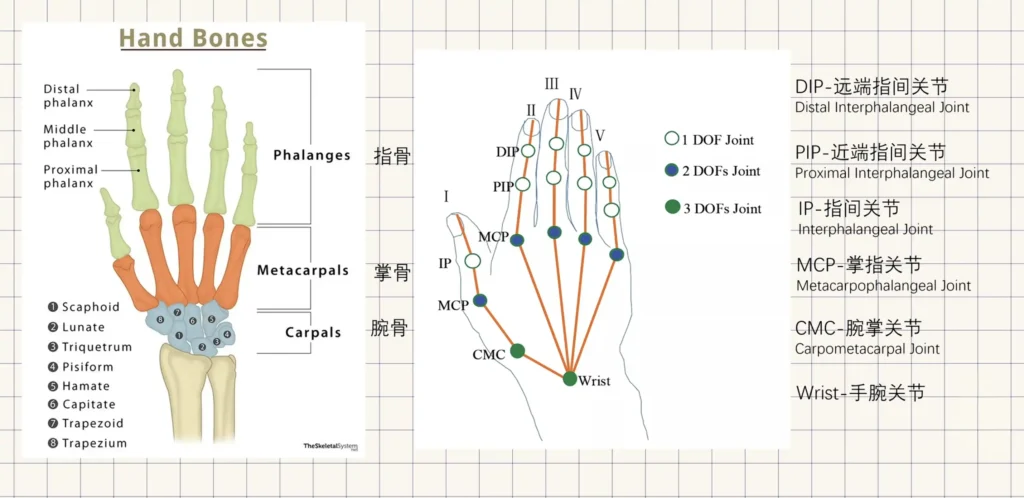
To meet these application requirements, the TSL-PG10K28-KW1317+LG04M20Z-END is suitable for independent actuation of MCP joints in dexterous robotic hands.
What Does an MCP Joint Require from an Actuator?
One of the main differences between a dexterous robotic hand and a conventional robotic gripper is the number of actuators involved.
A multi-DOF dexterous hand normally requires several actuators to be installed inside the palm and fingers. Therefore, an MCP joint actuator cannot be designed only around maximum torque. Size, weight, control requirements, wiring, and system integration must also be considered.
Compact Size
The internal space of a robotic palm must accommodate not only motors, but also control boards, communication cables, power cables, sensors, and other components. If a single actuator occupies too much space, it can directly limit the installation of other joint actuators and electronic components.
The TSL-PG10K28-KW1317+LG04M20Z-END combines a 10 mm planetary gearbox with a 13 mm coreless brushless motor and uses a worm-and-worm-gear structure to change the output direction.
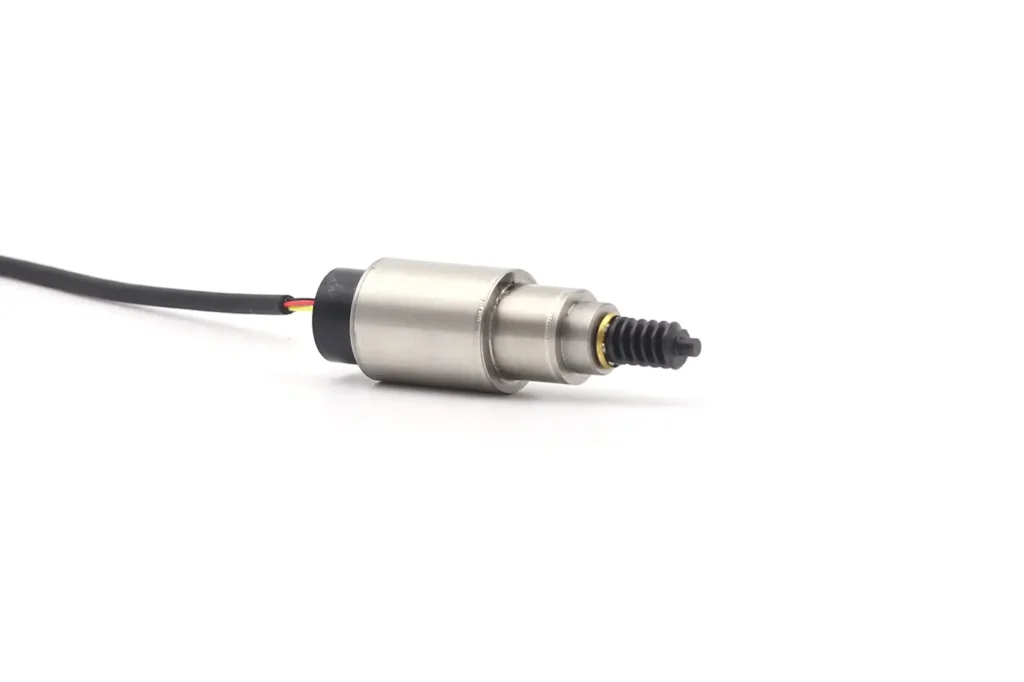
This arrangement is well suited for installation inside the palm, where the actuator output can be connected to the MCP joint through a suitable mechanical transmission mechanism.
Compared with the standard version, the END version further integrates the encoder and motor driver. The overall axial length increases by only approximately 5 mm. Although the actuator becomes slightly longer, it reduces the need for external driver boards and simplifies some of the internal wiring, which can make the overall layout of the dexterous hand easier.
Suitable Torque and Speed
An MCP joint does not simply require the highest possible speed.
During rapid finger opening and closing, the actuator needs enough speed to achieve a natural and responsive movement. After the finger contacts an object, however, the joint needs sufficient torque to continue applying grasping force.
The actuator uses a total reduction ratio of 1:560, consisting of:
- 1:28 planetary reduction stage;
- 1:20 worm-and-worm-gear reduction stage.
The main output specifications after reduction are:
- Operating voltage: 12 V
- No-load output speed: 50 ±10% RPM
- Rated output speed: 40 ±10% RPM
- Rated output torque: ≥0.75 N·m
- Peak torque for 2 seconds: 1.5 N·m
- Rated current: ≤1.5 A
- Peak current: ≤2.5 A
This performance range provides a practical balance between the normal flexion and extension speed of the MCP joint and the torque required during grasping operations.
Why Combine a Planetary Gearbox with a Worm Gear Transmission?
One of the common design challenges for dexterous-hand joint actuators is obtaining a high reduction ratio and sufficient output torque within a very limited installation space.
Using only multiple stages of conventional spur gears may require a relatively large amount of planar space. On the other hand, increasing the number of planetary gear stages can result in excessive axial length.
For this reason, the TSL-PG10K28-KW1317+LG04M20Z-END uses a combination of planetary reduction and worm gear transmission.
First, the 1:28 planetary gearbox provides primary speed reduction and torque amplification. The coaxial structure of the planetary gearbox makes it suitable for direct combination with a miniature coreless brushless motor.
The output then passes through a 1:20 worm-and-worm-gear stage for further speed reduction. At the same time, the worm gear mechanism changes the direction of power transmission, allowing the actuator output to be arranged in a direction more suitable for an MCP joint.
This is particularly useful for thin robotic palm structures in which several actuators need to be installed side by side.
In addition, the reverse self-locking torque of the worm gear transmission is greater than 3 N·m. In a dexterous hand, this characteristic can reduce dependence on continuous motor output during static holding.
For example, after grasping a cup, tool, or cylindrical object, the joint may need to maintain a fixed angle. The worm gear transmission can help maintain the joint position and reduce unnecessary continuous actuation.
What Are the Practical Benefits of the END Integrated Design?
For prototype development, it is not difficult to use a configuration consisting of a motor, gearbox, external encoder, and external motor driver.
However, as the number of degrees of freedom in a dexterous hand increases, system-level integration problems become more obvious.
For example, a four-finger or five-finger robotic hand may use several MCP actuators at the same time. If every actuator requires a separate motor driver and an additional installation location, valuable space inside the palm is consumed and the amount of wiring increases significantly.
The TSL-PG10K28-KW1317+LG04M20Z-END integrates the encoder and motor driver with the actuator itself. This provides several practical advantages.
First, fewer control components are required inside the palm.
Because the motor drive function is integrated directly into the actuator module, fewer separate miniature driver boards are needed.
This makes it easier to arrange the mechanical structure, sensors, control electronics, and other actuators inside the palm.
Second, the encoder signal transmission distance is reduced.
When the encoder is integrated with the actuator, position detection is concentrated within the joint module.
This reduces the need to route weak encoder signal lines over long distances inside the palm and helps simplify the electrical design.
Third, the design is more suitable for modular replacement.
In a modular dexterous-hand design, each MCP actuator can be treated as a relatively independent functional unit.
During later testing, repair, or maintenance, the actuator can be inspected and replaced as a joint module without repeatedly separating and rematching the motor, encoder, and driver.
Fourth, it simplifies closed-loop joint control.
The actual control target of an MCP joint is not simply motor speed. More importantly, it is the final joint angle and the complete motion process.
Encoder feedback provides the basis for joint position control, allowing the control system to adjust motor output according to the target motion.
For example, when grasping a cylindrical object, the fingers can initially close at a relatively high speed. As the fingers approach the expected contact position, the movement speed can be reduced.
After contact with the object is detected or confirmed, the actuator can enter a holding stage.
This multi-stage motion strategy is more suitable for dexterous robotic hands than controlling finger movement only through a fixed motor operating time.
Typical Installation Methods for MCP Joint Applications
In practical designs, the actuator can be installed inside the robotic palm, with the worm gear output positioned close to the MCP joint.
Depending on the mechanical architecture of the dexterous hand, several transmission arrangements can be used.
Option 1: Direct Actuation Near the Joint
The actuator is installed close to the MCP joint, and its output drives the joint shaft through a suitable connector.
This arrangement provides a short and clear power transmission path and is suitable for robotic hands with sufficient space around the MCP joint.
Its main advantage is the reduced number of intermediate transmission components, making installation, adjustment, and maintenance relatively simple.
Option 2: Linkage-Based Actuation
The actuator is installed inside the palm and drives the MCP joint through a short linkage mechanism.
This arrangement provides greater flexibility in actuator placement and can be adapted to different palm sizes and internal layouts.
It is useful when the MCP joint axis and actuator output axis cannot be directly aligned.
Option 3: Coupled Actuation of the MCP and Other Finger Joints
Some dexterous hands use underactuated mechanisms in which one actuator influences several joints, such as the MCP and PIP joints, through linkages, tendons, or differential mechanisms.
This arrangement can reduce the total number of actuators and lower the overall weight of the robotic hand.
The TSL-PG10K28-KW1317+LG04M20Z-END can serve as the main power source in such a system, with coordinated multi-joint flexion achieved through mechanical design.
However, this type of system requires the transmission ratio and mechanical geometry to be redesigned according to finger length, joint range of motion, and required grasping force.
Suitable Dexterous-Hand Applications
Based on its mechanical structure and output characteristics, this MCP joint actuator can be applied to different types of robotic hand systems.
In humanoid robot dexterous hands, it can be used to drive MCP flexion and extension of the index, middle, ring, and little fingers.
In industrial robotic dexterous end-effectors, it can support tasks such as small-part grasping, sorting, handling, and assembly.
In service robots, it can be used for operating common tools, holding bottles and containers, and performing basic household manipulation tasks.
The actuator can also be used in research and development platforms where a compact and integrated MCP joint solution can reduce the amount of repeated hardware development associated with motor drive and position feedback.
However, different dexterous hands have different requirements for joint speed, torque, installation layout, and control interfaces. Therefore, the actuator should still be matched with the specific mechanical structure and control architecture of each robotic hand project.
Customization for Different MCP Joint Designs
There is currently no completely unified mechanical and electrical standard for dexterous robotic hands.
Different manufacturers use different palm dimensions, joint ranges of motion, mechanical layouts, and control architectures.
Therefore, the TSL-PG10K28-KW1317+LG04M20Z-END can be adjusted according to project requirements, including:
- Adjusting the operating voltage and winding parameters according to the robot power system;
- Changing the reduction ratio according to the required joint speed and grasping force;
- Modifying the output shaft or output interface according to the mechanical structure;
- Adjusting the mounting arrangement and cable direction;
- Selecting suitable drive and feedback configurations according to the control system;
- Customizing cable length and connector type according to the available space inside the palm.
This approach can reduce the need to redesign the complete robotic-hand structure around a standard motor and allows the actuator and MCP joint mechanism to be matched more effectively.
Conclusion
The MCP joint is one of the main powered joints that enables finger flexion, enveloping grasping, and stable object holding in a dexterous robotic hand.
Its actuator must solve several problems at the same time within a limited installation space, including torque output, movement speed, position feedback, wiring, and continuous operation.
The TSL-PG10K28-KW1317+LG04M20Z-END combines a 12 V coreless brushless motor, a 1:28 planetary gearbox, and a 1:20 worm-and-worm-gear transmission, providing a total reduction ratio of 1:560.
The END version further integrates the encoder and motor driver while increasing the axial length by only approximately 5 mm, providing a compact and easy-to-integrate actuator solution for MCP joints in dexterous robotic hands.
For teams developing humanoid robotic hands, industrial manipulation hands, or research-oriented multi-finger robotic platforms, this highly integrated miniature joint actuator can reduce repeated integration work between mechanical, electrical, and control systems.
As a result, developers can focus more of their efforts on overall hand architecture, grasp planning, motion coordination, and control algorithms.