A game controller is an important interface between the player and the game world. Buttons, joysticks, and triggers handle user input, while the vibration system converts collisions, explosions, weapon recoil, vehicle engines, and changes in road surface into tactile feedback that the player can feel.
A suitable Game Controller Haptic Feedback Motor makes different in-game events easier to distinguish and strengthens the connection between visual, audio, and tactile cues.
As game controllers move toward more nuanced haptic experiences, a vibration motor cannot be evaluated solely by how strong it feels. Start and stop speed, vibration direction, noise, power consumption, and structural resonance after installation all affect the final experience.
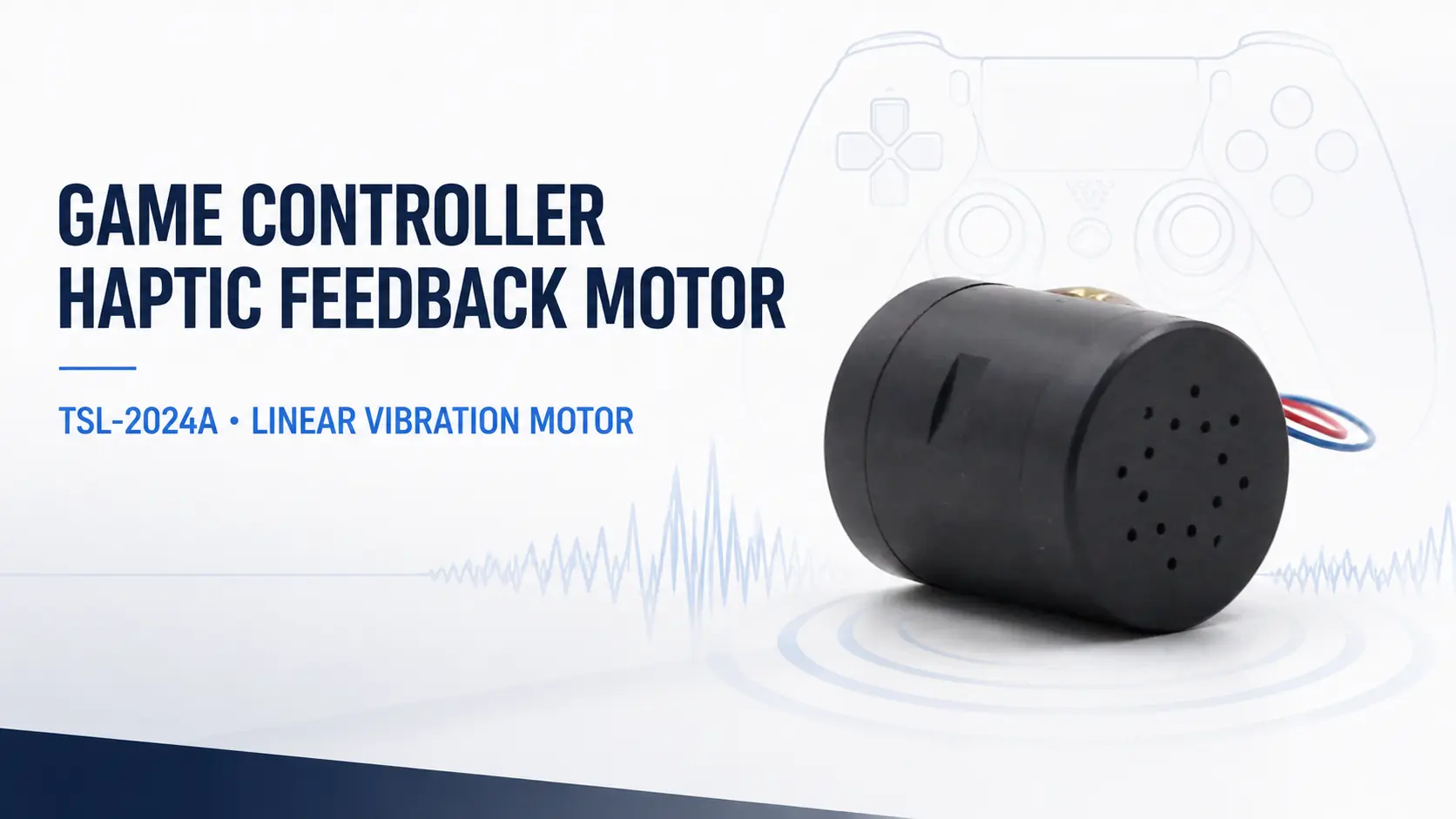
The TSL-2024A is a Z-axis Linear Vibration Motor designed for game controller applications. Its low-frequency operating characteristics and relatively high vibration acceleration make it suitable for representing collisions, engine vibration, and other in-game events with a sense of weight.
At a Glance
Haptic feedback in a game controller must balance vibration strength, response speed, power consumption, and structural noise. A conventional ERM eccentric rotating mass motor generates vibration by rotating an eccentric mass and has a relatively simple structure and drive method.
In contrast, an LRA linear vibration motor uses an AC signal to drive an internal spring-mass system along a defined direction, making it more suitable for haptic feedback designs that require directional output and controlled response.
The TSL-2024A is a Z-axis Linear Resonant Actuator with a diameter of 20 mm and a height of 24 mm. It has a rated voltage of 1.2 Vrms AC, a rated frequency of 65 ± 10 Hz, and a vibration acceleration of 2.5 ± 0.5 Grms.
How Haptic Feedback Improves the Game Controller Experience
Vibration in a game controller is more than an optional feature. By varying its intensity and duration, it can help players distinguish between in-game events. For example, short vibrations can represent gunfire and minor collisions, continuous vibration can simulate a vehicle engine, and stronger pulses are suitable for explosions, heavy impacts, or character damage.
If vibration actuators are installed in the left and right grips and controlled independently, they can also create directional haptic cues. Differences in the vibration felt on each side can help the player sense the direction of a collision, changes in road surface, or the source of danger in the game.
The Microsoft game‑controller allows different vibration intensities to be set for separate vibration channels, producing diverse haptic effects by combining multiple actuators.
What Game Controller Manufacturers Need From a Haptic System
A vibration system suitable for a game controller must address more than whether it can generate vibration. For controller mechanical and electronics engineers, the more important question is whether different in-game events can produce clear, stable, and repeatable haptic feedback.
In practical development, the following requirements should generally be considered:
- Vibration should build and stop promptly to reduce trailing vibration between different feedback events;
- Different amplitudes and durations should create distinguishable tactile sensations;
- Strong vibration should not cause obvious housing noise or loosen components;
- Vibration performance should remain consistent between the left and right grips;
- The actuator must fit within limited internal space;
- Wireless controllers must control current consumption to minimize the impact on battery life;
- Mass-produced units should maintain similar resonant frequencies and vibration acceleration.
This means that vibration motor specifications are only the starting point for selection. The driver circuit, mounting orientation, fastening rigidity, and overall controller structure all affect the feedback ultimately felt by the player.
Common Problems With Conventional Gamepad Vibration
Some game controllers still use relatively simple vibration control methods, such as running the motor continuously at a fixed intensity. This approach can produce noticeable vibration, but the distinction between different in-game events may not be sufficiently clear.
If the actuator starts too slowly, a brief gunshot or collision feedback event may end before the vibration reaches its target intensity. If the stop time is too long, residual vibration from one event may overlap with the next. In addition, mounting clearances, insufficient bracket rigidity, or localized housing resonance may convert normal vibration into knocking sounds and mechanical noise.
Increasing the drive voltage is not a universal solution to these problems. Excessive voltage may increase current, temperature rise, and mechanical stress without necessarily improving the level of haptic detail. For an LRA, whether the drive frequency is close to the actual resonant frequency is often more important than simply increasing the voltage.
ERM or Linear Vibration Motor: Which Fits the Controller?
A game controller can use either an ERM vibration motor or a Linear Resonant Actuator. Because the two solutions differ in structure and control logic, the choice should be based on the target tactile feel, drive system, available installation space, and cost.
| Comparison | Linear Vibration Motor | ERM Vibration Motor |
| Motion | Linear oscillation | Eccentric rotation |
| Drive Method | AC waveform | DC voltage or PWM |
| Vibration Direction | Defined axis | Distributed through the housing |
| Main Control Variables | Amplitude, waveform and duration | Speed, voltage and duration |
| Operating Characteristic | Best performance near resonance | Vibration changes with rotational speed |
| Typical Design Benefit | Directional and controlled feedback | Simple driving and familiar rumble effect |
An ERM motor uses a DC motor to rotate an eccentric mass, so vibration frequency and intensity generally change with rotational speed. An LRA uses an AC signal to drive an internal mass in reciprocating motion, allowing vibration amplitude and duration to be adjusted at a relatively stable operating frequency.
Therefore, the TSL-2024A is not a conventional rotating Gamepad Rumble Motor. It is a Game Controller Linear Resonant Actuator that outputs vibration along the Z-axis.
Introducing the TSL-2024A Linear Vibration Motor
The TSL-2024A has a cylindrical structure measuring Ø20 ± 0.3 mm in diameter and 24 ± 0.5 mm in height. Driven by an AC signal, its internal spring-mass system moves back and forth along the Z-axis and produces perceptible vibration output when operating near its resonant frequency.
A Linear Resonant Actuator uses AC voltage to drive an internal voice coil and a moving mass connected to a spring, producing vibration along a single axis.
This operating principle is clearly different from that of an ERM motor. The TSL-2024A does not rely on a continuously rotating eccentric mass to generate vibration. Therefore, articles and product materials should not describe it using ERM parameters such as rated speed, eccentric-mass rotational speed, or DC speed control.
How the TSL-2024A Creates Game Controller Feedback
The TSL-2024A has a rated frequency of 65 ± 10 Hz, making it better suited to emphasizing low-frequency feedback with a sense of weight, such as vehicle engines, collisions, explosions, and heavy impacts.
Its vibration acceleration of 2.5 ± 0.5 Grms can provide noticeable tactile output in a game controller, although the final sensation still depends on the mechanical coupling between the actuator and the housing.
A maximum rise time of 50 ms means that the actuator requires a certain amount of time to build vibration after startup, while a maximum fall time of 80 ms reflects the decay process after the drive stops. The product should therefore not be promoted as having “zero latency” or “instant stopping.” Instead, haptic waveforms should be designed around these actual response data.
Developers can obtain different feedback effects by adjusting drive amplitude and duration, for example:
Short-duration drive for gunfire, button confirmation, and minor collisions;
Medium-duration drive for weapon recoil and character impacts;
Longer periodic drive for vehicle engines and road-surface feedback;
Independent control of the left and right actuators to represent directional changes.
These game effects are jointly created by the controller, driver circuit, and software waveform; they are not fixed effects preset inside the motor.
Electrical Integration Requirements
The TSL-2024A has a rated input of 1.2 Vrms AC and therefore cannot be connected directly to a regulated DC power supply. The game controller must use an LRA driver circuit capable of generating a bidirectional AC waveform, with the drive frequency set near the actuator’s actual resonant frequency.
The electrical design should focus on confirming the following:
- Whether the driver’s LRA operating-frequency range includes 65 Hz;
- Whether the output voltage can be limited to the 0.1-1.2 Vrms AC range;
- Whether the output stage can meet the maximum 200 mA requirement;
- Whether amplitude, duration, and braking control are supported;
- Whether closed-loop tracking can compensate for shifts in resonant frequency;
- Whether the battery and power-management system can withstand load changes caused by repeated startup.
Not every driver IC labeled as supporting LRA operation is suitable for the TSL-2024A. Some common smartphone haptic drivers are designed primarily for higher-frequency LRAs and may be unable to perform automatic resonance tracking near 65 Hz.
For example, TI’s DRV2624 supports automatic LRA resonance tracking over a range of 45-300 Hz. From a frequency-range perspective, they can be considered for evaluation, but matching tests are still required based on load impedance, back EMF, output voltage, and control mode.
Mechanical Installation Inside the Game Controller
The actual performance of an LRA is closely related to its mounting structure. Because the TSL-2024A outputs vibration along the Z-axis, it should be installed with the Z-axis aligned with the intended direction of vibration transmission. If the orientation is incorrect, part of the energy may be absorbed by the housing structure, reducing the vibration felt at the controller surface.
The actuator should be securely mounted to the main controller body or to a load-bearing structure in the grip. Excessively soft adhesive pads may absorb vibration, while excessive assembly clearance may cause knocking sounds.
The mounting structure must also withstand repeated vibration and drop impacts to prevent loosening after long-term use.If one TSL-2024A is installed in each grip, independent control can create left-right directional feedback. Microsoft’s GamepadVibration interface also provides independent intensity control for the left and right vibration channels, showing that a multi-actuator arrangement is a common system architecture in game controllers.
Customization for Different Controller Designs
Game controllers vary in internal space, battery voltage, target tactile feel, and assembly method. As a vibration motor manufacturer, TSL can evaluate the following customization options based on the customer’s controller structure and control system:
- Operating voltage and rated frequency;
- Vibration acceleration;
- Housing diameter and height;
- Lead-wire length and wire-exit direction;
- Connector type;
- Mounting structure;
- Dual-actuator configuration for the left and right grips;
- Response time.
To shorten the selection process, customers can provide the available internal space, supply voltage, drive method, target vibration intensity, mounting orientation, sample quantity, and estimated annual demand. Based on this information, the TSL engineering team can evaluate either a standard model or a customized solution.
Recommended Prototype Validation
A vibration motor should not be evaluated only while suspended in free air. Sample testing should be performed in a complete game controller or in a structure close to the intended production design, because controller weight, material, mounting method, and the way the player holds the controller all affect the actual vibration sensation.
The following items are recommended for validation:
- Perform a frequency sweep around 65 Hz to determine the optimal operating point after installation;
- Measure actual vibration acceleration at different drive amplitudes;
- Test rise time, fall time, and residual vibration;
- Check for housing noise, looseness, and localized resonance;
- Compare vibration consistency between the left and right grips;
- Measure operating current and temperature rise during continuous operation;
- Evaluate the effect of the vibration function on wireless-controller battery life;
- Conduct drop and cycle-life testing;
Check consistency among different actuator batches under the same drive conditions.An LRA’s resonant frequency may be affected by temperature, aging, mounting structure, and grip conditions. TI’s driver documentation also notes that automatic resonance tracking helps maintain relatively stable vibration output as operating conditions change.
Conclusion
The haptic experience of a game controller depends on the combined interaction of the actuator, driver circuit, control waveform, and mechanical structure. Simply increasing vibration intensity does not guarantee a better gaming experience. Clear startup and stopping behavior, the correct vibration direction, reasonable power consumption, and stable consistency in mass production are equally important.
The TSL-2024A is a 65 Hz Z-axis Linear Vibration Motor designed for game controller haptic feedback. With a rated drive of 1.2 Vrms AC, it provides 2.5 ± 0.5 Grms vibration acceleration, a maximum rise time of 50 ms, a maximum fall time of 80 ms, and a cycle life of 1,000,000 operations. It can be used to design feedback for vehicles, collisions, explosions, recoil, and directional cues.
If you are developing a wired or wireless game controller, please provide the available installation space, power-supply conditions, drive method, target vibration sensation, and estimated demand. TSL Motor can help evaluate the system compatibility of the TSL-2024A and provide customization support for lead wires, connectors, structure, and performance.
FAQ
Q1:Is the TSL-2024A an ERM vibration motor?
No. It is a Z-axis Linear Resonant Actuator that uses an AC drive signal.
Q2:Can the TSL-2024A operate directly from DC power?
No. It requires an LRA driver that can generate an AC waveform near its rated frequency.
Q3:What does 2.5 ± 0.5 Grms mean?
It is the specified vibration acceleration, not mechanical force measured in newtons.
Q4:Can two TSL-2024A actuators be used in one controller?
Yes. One actuator can be installed in each grip to provide independently controlled left and right feedback.