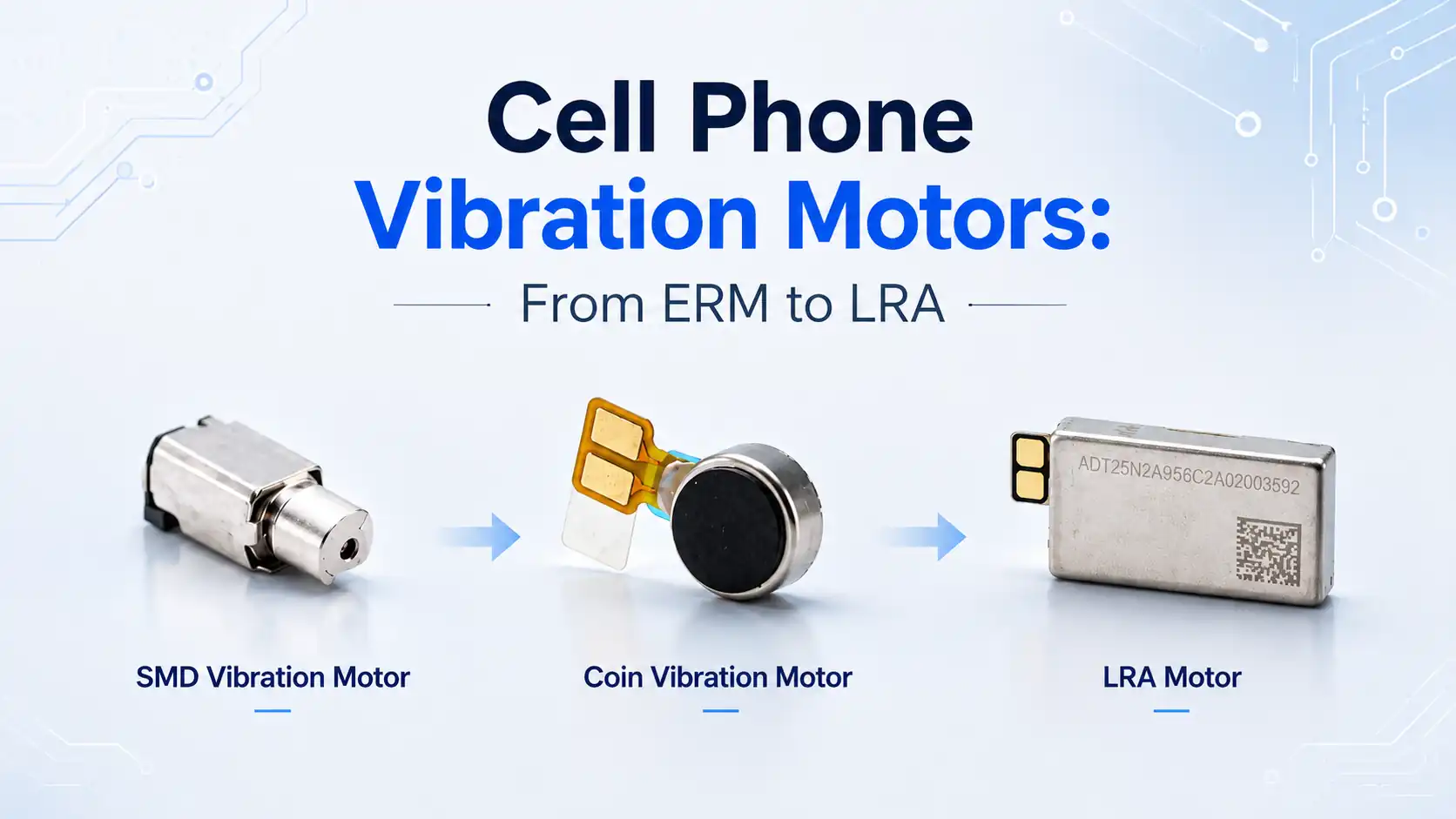
Phone vibration looks like a trivial feature. It reminds users of calls, messages and typing inputs. Few people notice the tiny vibration motor inside the device.
Engineers have upgraded phone vibration motors step by step. ERM motors dominated early phones for basic stable vibration. Flat coin-shaped ERM versions fit better into slim phone bodies later.
Modern flagship phones demand delicate layered tactile feedback. Scenes like gaming and virtual keys need diverse vibration effects. Thus LRA linear resonant actuators become the mainstream choice.
The three common vibration motor technologies can be compared as follows:
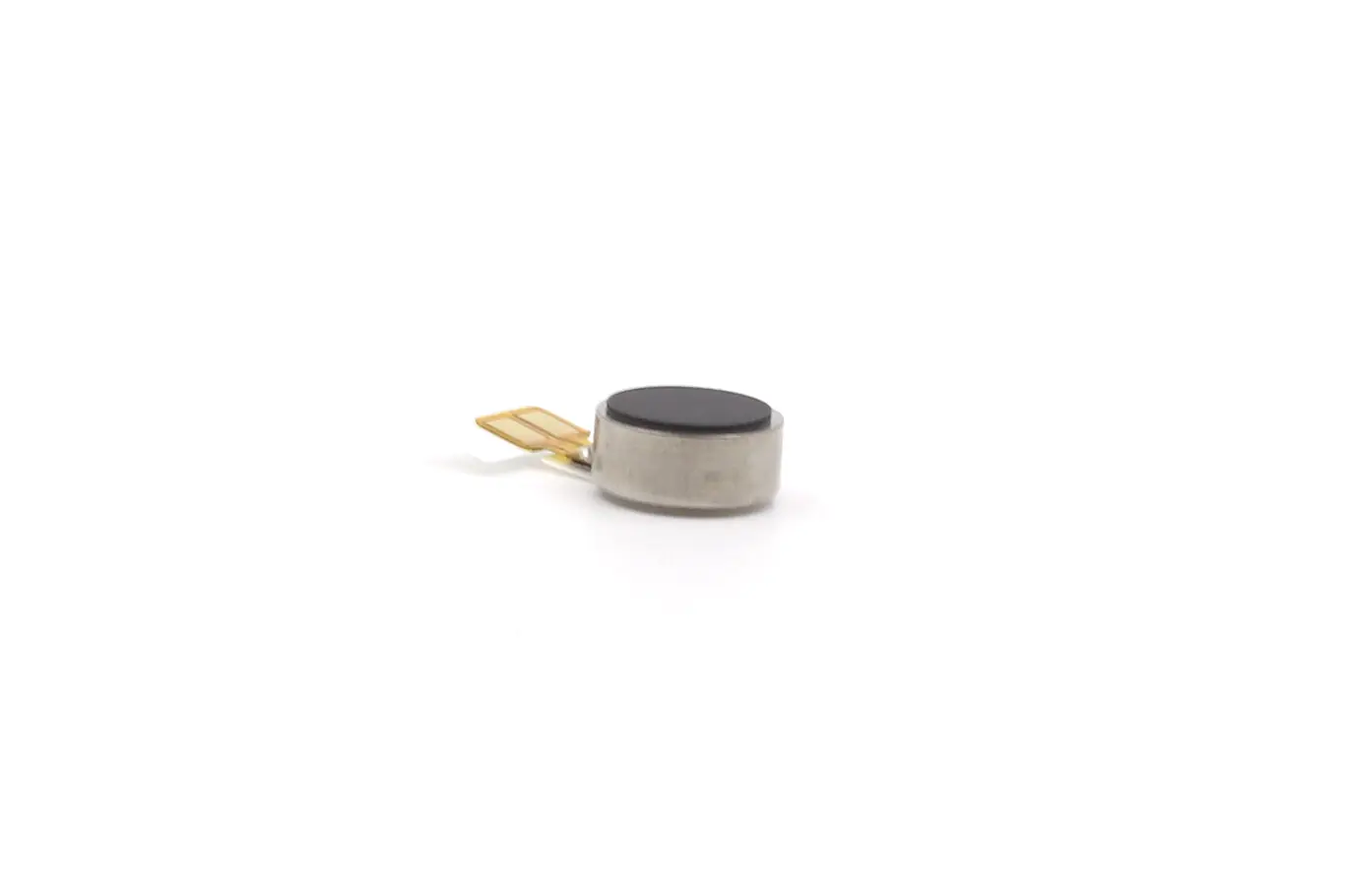
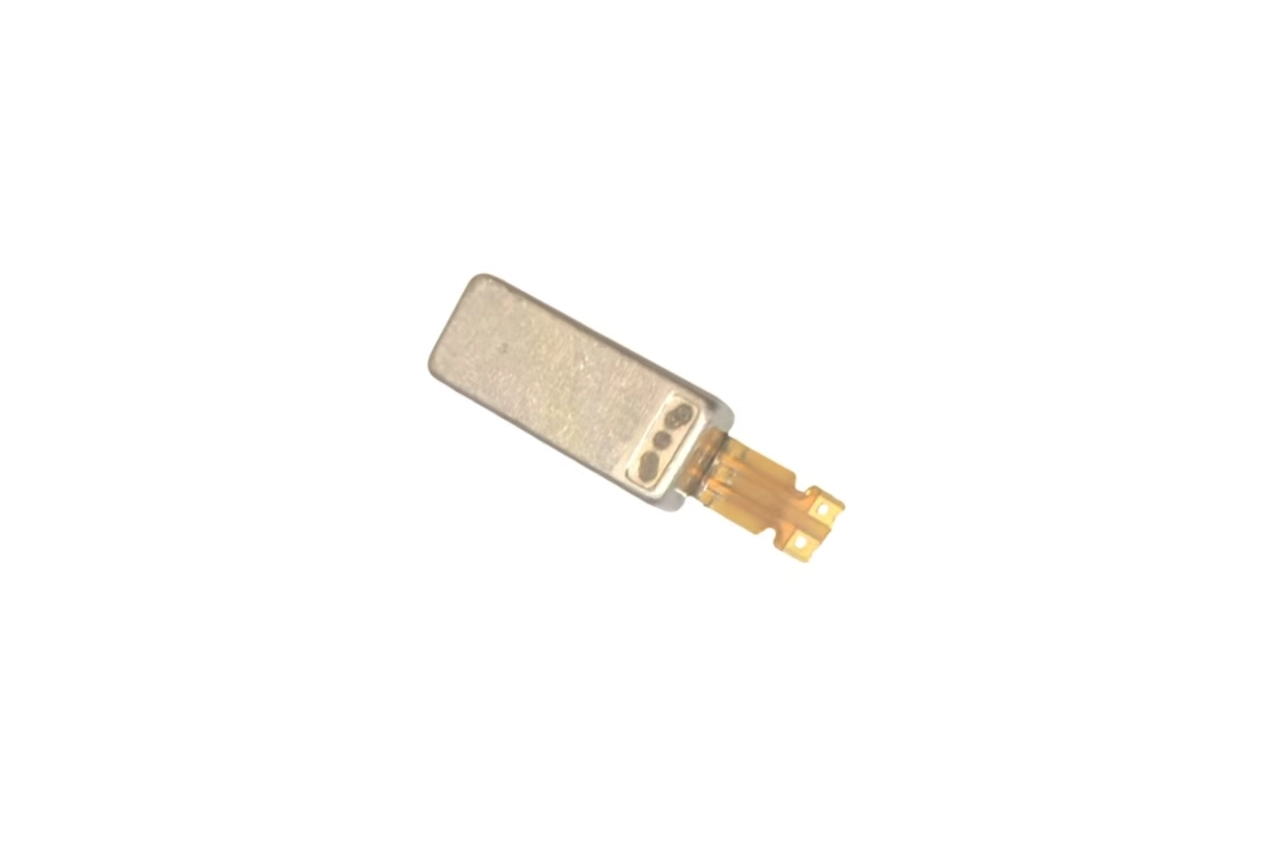
| Type | SMT/SMD Vibration Motor | Coin Vibration Motor | LRA Motor |
| Image |
 |
 |
 |
| Operating principle | Rotating eccentric mass | Rotating eccentric mass | Linear reciprocating mass |
| Drive complexity | Low | Low | Higher |
| Shape | Cylindrical or compact SMD package | Flat and round | Rectangular or coin-shaped |
| Vibration feel | Strong but relatively rough | Similar to conventional ERM | Shorter and more refined |
| Response speed | Slower | Slower | Faster |
| Control capability | Basic | Basic | Advanced |
| Smartphone suitability | Simple structure | Good for thin devices | High-quality haptic feedback |
| Typical application | Basic vibration alerts | Thin consumer electronics | Smartphones and haptic devices |
Key Takeaways
- ERM motors are simple and cost-effective.
- Coin ERM motors save installation space.
- LRA motors provide faster response.
- LRA vibration feels more precise and refined.
- ERM motors are easier to drive.
- LRA motors usually require a dedicated driver IC.
- Modern cell phone vibration motors are evolving toward haptic feedback.
Early Stage: SMT Vibration Motors
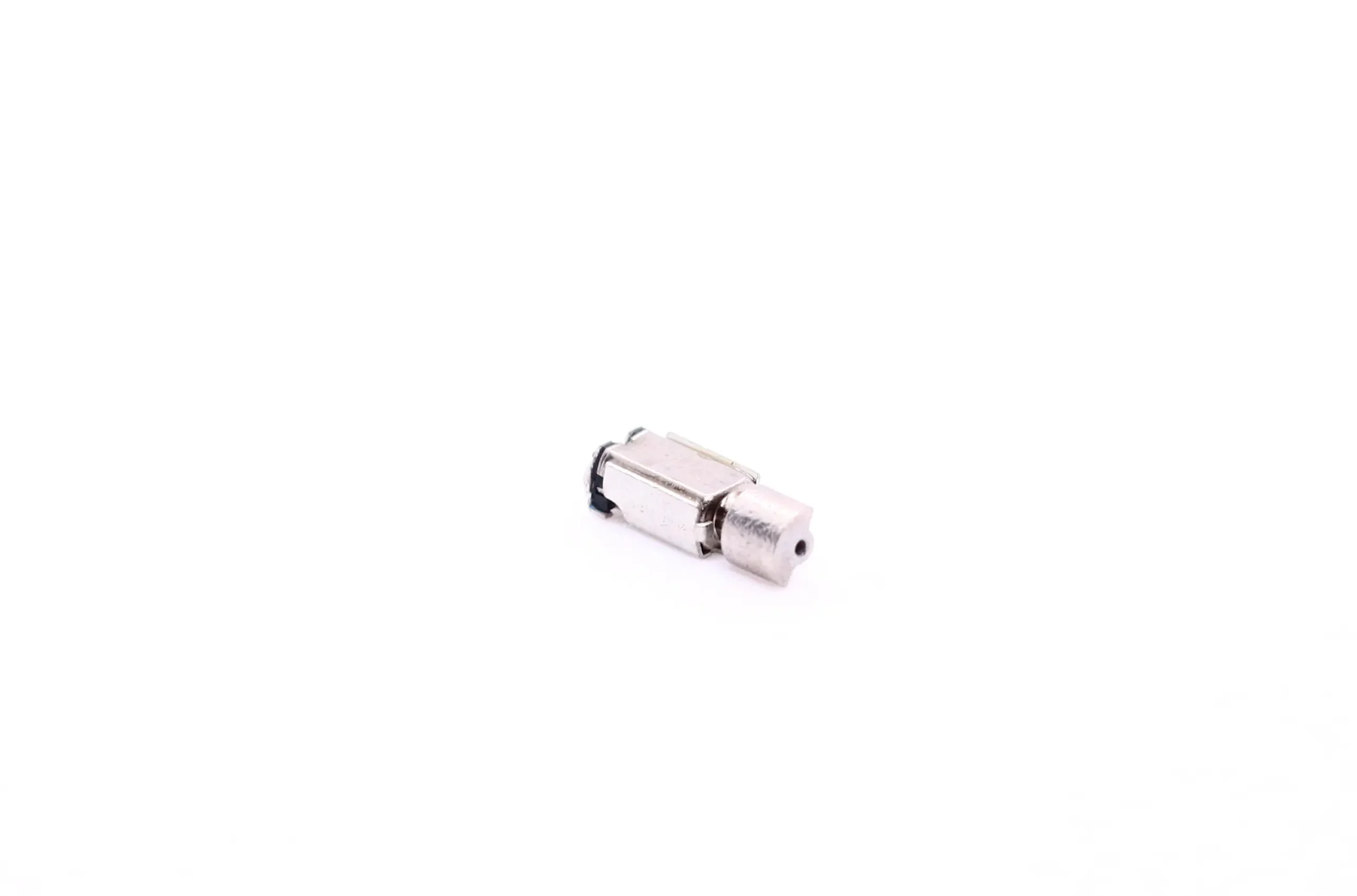
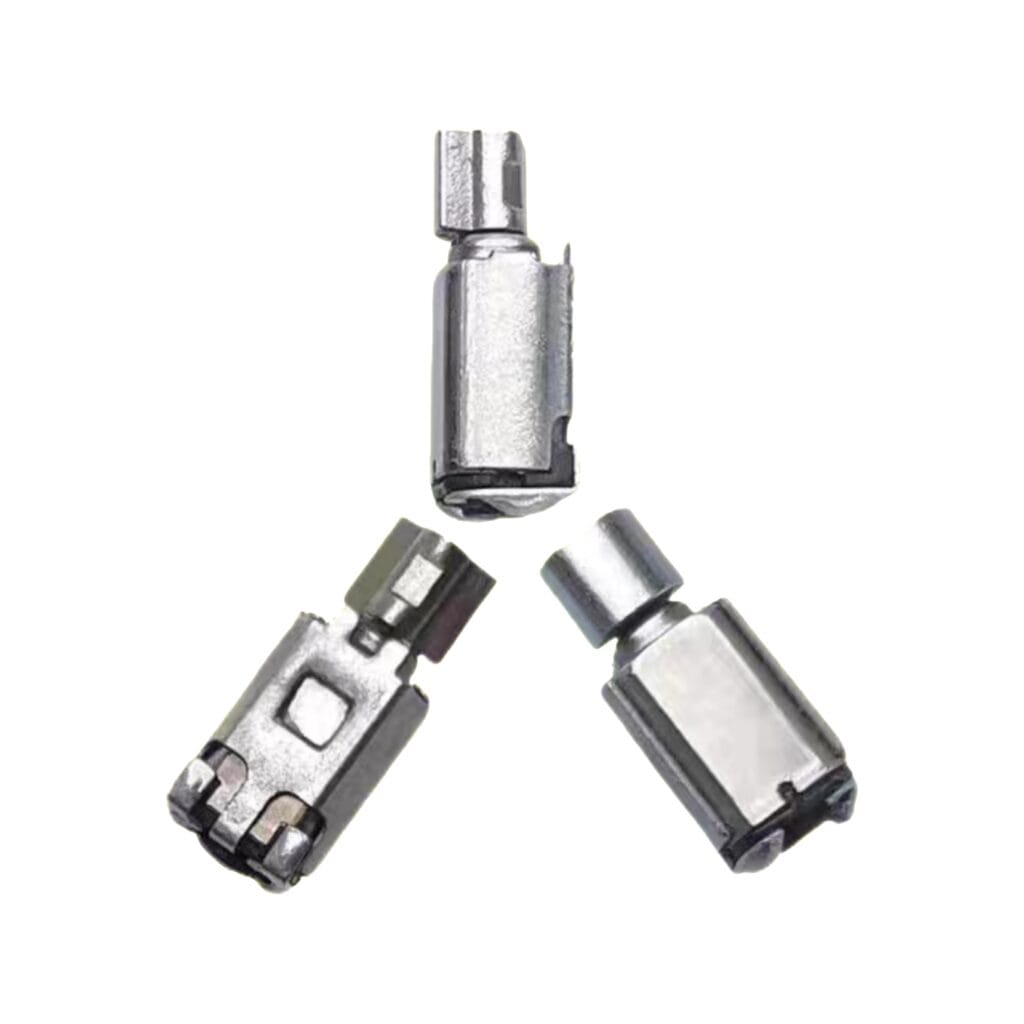
SMT vibration motors can generally be understood as miniature ERM vibration motors designed for surface-mount production.
Operating Principle
The SMT surface-mount form factor was the most common packaging style in early feature phones and the first generation of smartphones. It is soldered directly onto the motherboard using standard surface-mount techniques—eliminating the need for extra wire harnesses. High efficiency in automated SMT production was the primary driver behind its widespread adoption.
It belongs to the ERM (Eccentric Rotating Mass) vibration motor family—the earliest vibration motor type mass-produced for mobile devices.
The underlying principle is very straightforward: an asymmetric eccentric weight is attached to the rotor shaft of a miniature DC motor. When powered, the motor spins the eccentric weight at high speeds. The resulting unbalanced centrifugal force radiates outward, causing the motor casing—and ultimately the entire phone—to vibrate.
Advantages
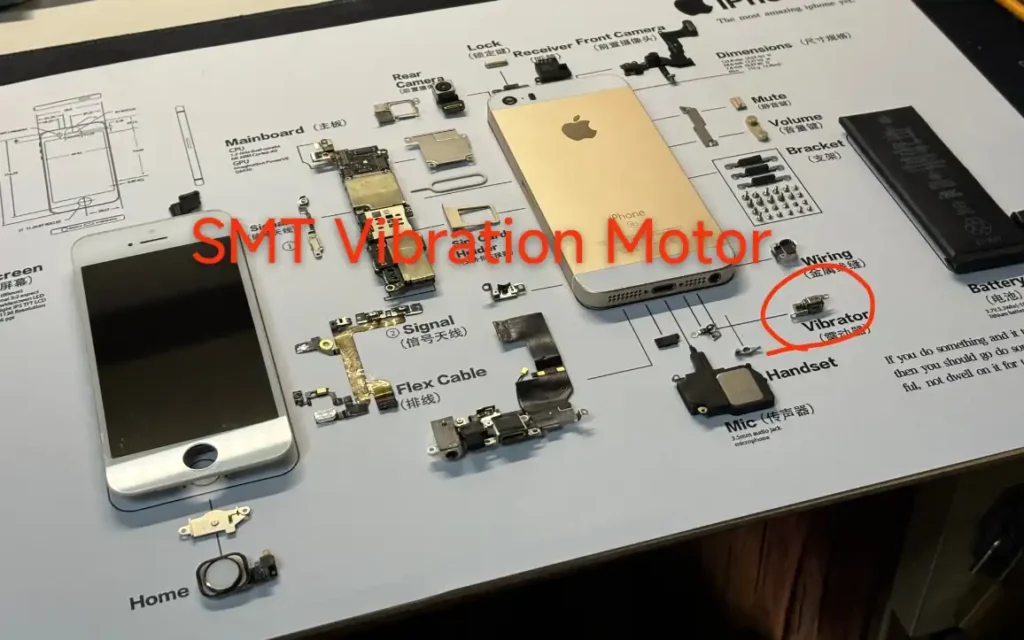
Apple used this cylindrical SMT-mount ERM vibration motor as standard across models from the original iPhone through to the iPhone 3GS and standard iPhone 4. It was the universal choice across the entire mobile phone industry at the time.
In the hardware ecosystem around 2010, it perfectly addressed the two most critical needs for manufacturers: low cost and plug-and-play simplicity.
This motor offers three main advantages:
- Low Driving Requirement: It starts vibrating immediately when supplied with a direct current (DC) voltage, requiring no external driver ICs or frequency tuning circuits. The motherboard only needs a simple switch circuit to control power on/off, keeping hardware design complexity near zero.
- Extremely Mature Process: Backed by decades of refinement in miniature brushed motor mass production, it offers low failure rates and exceptionally cheap bulk procurement, significantly cutting the overall bill of materials (BOM) cost.
- High Installation Compatibility: The SMT package allows for automated assembly line soldering, making it ideally suited for the high-density component layouts of early smartphone motherboards.
Disadvantages
Constrained by its rotational physical structure, the key shortcomings of the SMT ERM motor became increasingly obvious through long-term iPhone usage, ultimately leading to its retirement:
- Large Spatial Footprint: Takes up substantial internal space.
- Coarse Vibration Feel: Lacks tactile nuance or granular feedback.
- Prominent Operating Noise: Low acoustic refinement with noticeable buzzing.
- Inefficient Power Consumption: Relatively high energy draw.
In short, the SMT ERM motor merely solved the basic problem of whether a phone could vibrate. It fell far short of meeting user demands for refined, high-quality haptic feedback. As smartphones entered an era of precise tactile interactions, replacing this technology became inevitable.
Mid-Stage: Coin Vibration Motor
To address the bulky footprint of SMT cylindrical ERM motors, motor manufacturers redesigned the structural geometry of the ERM rotor. While keeping the core principle of eccentric rotor vibration intact, they compressed the overall form factor into a thin, disc-like shape—known in the industry as a coin vibration motor (or pancake motor).
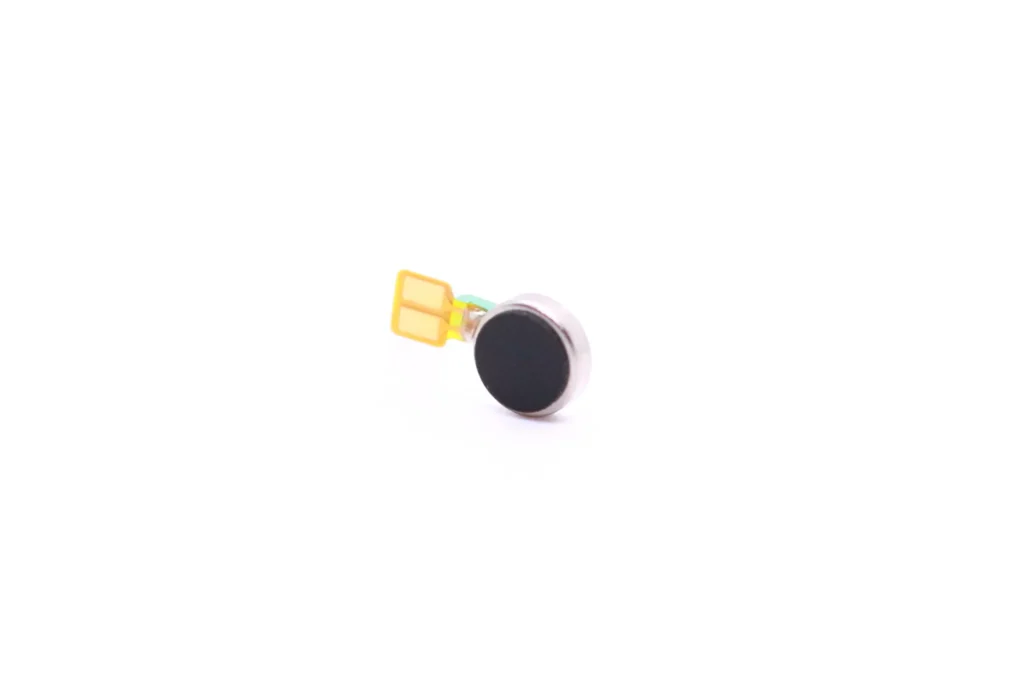
It still falls under the category of ERM eccentric rotor motors; the underlying principle was not upgraded, only its physical shape was optimized. Flatness was the sole breakthrough of this transitional product.
Advantages
Apple tested flat coin ERM motors on a small scale in two models—the CDMA iPhone 4 and the iPhone 4S—serving as a short-term trial of the technology.
- Stacking-Friendly Form Factor: The ultra-thin flat structure aligned well with hardware trends like expanding batteries and dense component integration, fixing the height bottleneck of cylindrical motors.
- Smooth Cost Transition: Sharing the same brushed ERM rotor architecture meant supply chains were already mature. The slight price increase posed no significant pressure on retail pricing.
- Backward-Compatible Design: Motherboard circuitry did not require a complete redesign; it could directly reuse existing ERM driver circuits, keeping hardware modification costs low.
Disadvantages
Because the coin ERM motor relies on rotational eccentric vibration at its core, it inherited all fundamental flaws of the ERM architecture: lack of fine vibration control, slow response times, mushy tactile feel, and noticeable operational noise.
As Apple began planning interaction features like 3D Touch pressure sensitivity and simulated press feedback for virtual Home buttons, ERM rotor motors proved entirely incapable of processing complex tactile commands.
Apple even temporarily reverted to SMT ERM motors in the iPhone 5, iPhone 5s, and iPhone 5c generations. This proved that the coin ERM motor was merely a compromised stopgap—a temporary solution that offered “ample space optimization, but insufficient experience upgrade,” dooming it to total replacement by a new generation of linear motors.
Modern Era: LRA Motor
As smartphones entered the touchscreen era, vibration took on a new role. At this point, vibration was no longer just an alert—it evolved into Haptic Feedback.
Operating Principle
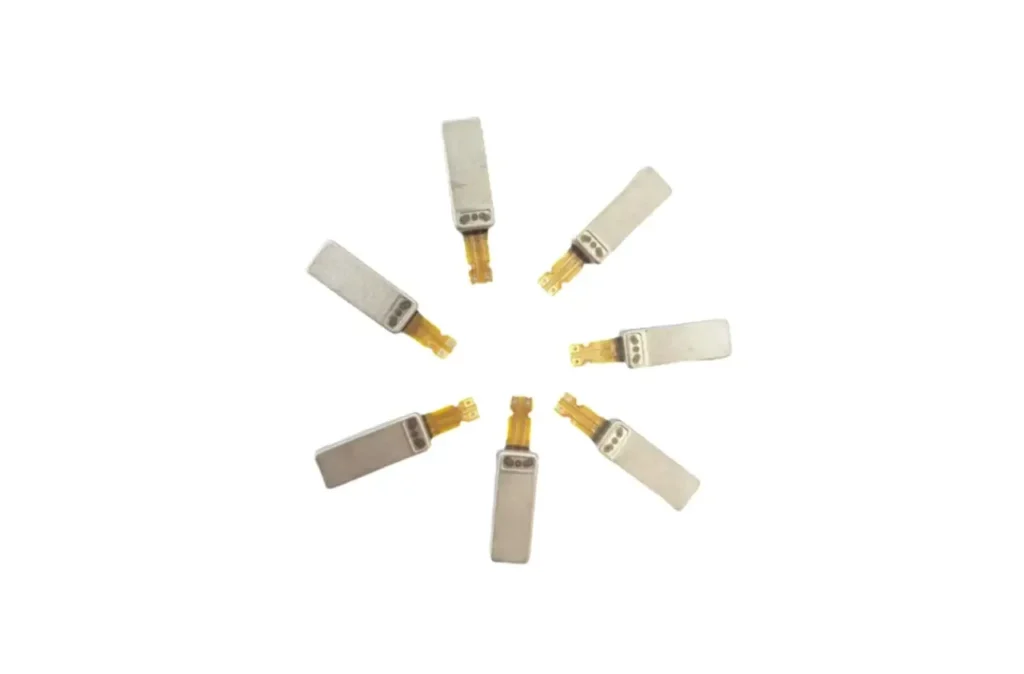
LRA stands for Linear Resonant Actuator. It completely abandons the rotational eccentric mass of ERM motors, adopting a brand-new architecture based on a spring and a permanent magnet mass undergoing linear reciprocating motion.
Operating similarly to a miniature voice coil speaker or a small pile driver, an LRA relies on electromagnetic force to drive an internal weight back and forth along a single axis, generating vibration through resonance.
In the industry, LRAs are categorized into two physical form factors based on their vibration axes:
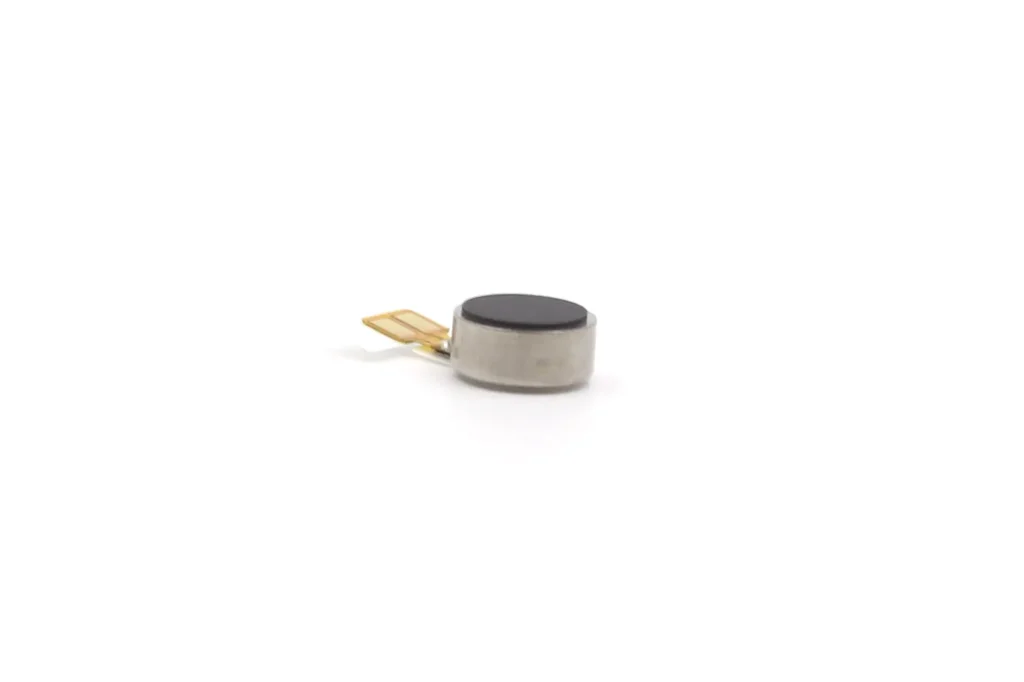
- Coin LRAs (Z-axis Linear Motors): Featuring a flat disc design, the mass vibrates vertically (perpendicular to the screen). They have a short stroke and relatively weak vibration, making them common in entry-level low-end phones and smart bands.
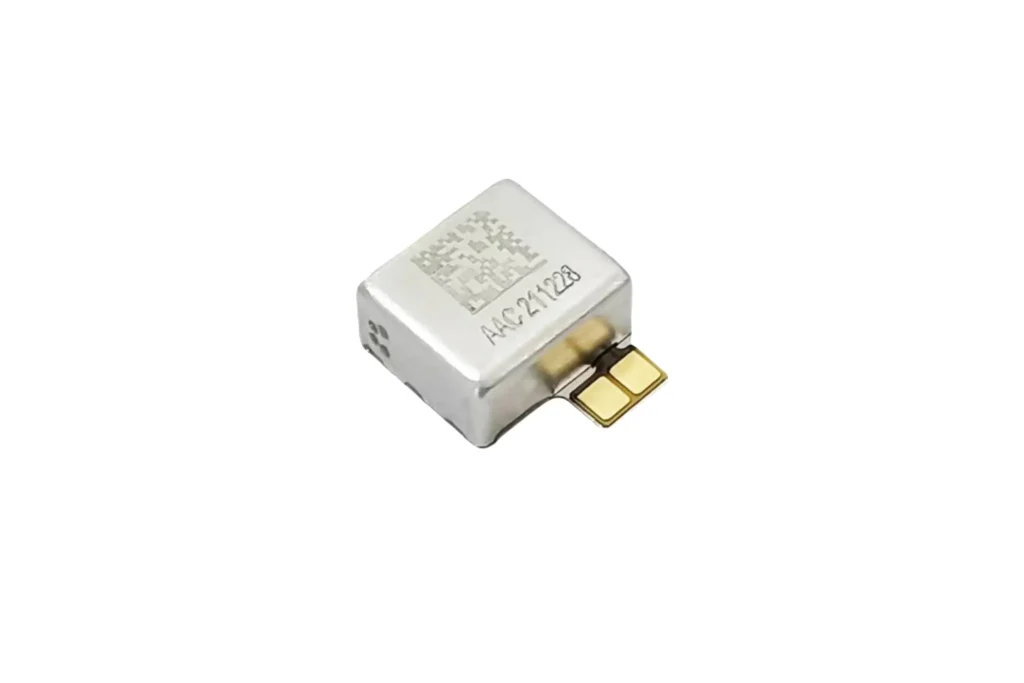
- Rectangular X-axis Linear LRAs: Featuring a elongated rectangular structure, the mass moves back and forth parallel to the long edge of the screen. They deliver a longer stroke, stronger peak vibration force, and crisper feedback. Rectangular X-axis LRAs are the absolute standard in flagship smartphones. Apple has adopted this solution across its entire lineup from the iPhone 6 series to the present day, branded as the Taptic Engine.
Advantages
Apple is a pioneer in deeply unlocking the value of LRA motors in consumer electronics, leading the entire evolution of rectangular X-axis linear motors from early prototypes to full maturity.
- Refined and Precise Vibration Feel
- Extremely Fast Response Times: Rapid start and stop times with no noticeable inertial lingering vibration (aftershocks).
- Low Operational Noise
- Lower Power Consumption: Resonant operation maximizes energy efficiency.
- High Functional Scalability
Disadvantages
Despite their strong technical advantages, LRAs have a significantly higher implementation threshold than ERM motors, which explains why low-to-mid-end devices took much longer to adopt them:
- Complex Driver and Control Logic: Requires dedicated driver ICs.
- High Software and Hardware Tuning Costs: Highly dependent on complex haptic algorithms.
- Higher Hardware Procurement Costs
- Mechanical Life Limits: Susceptible to physical wear over extended cycles.
Driver Differences
The biggest difference between ERM and LRA lies in their driving logic and control complexity. ERM driving is simple and direct, relying solely on voltage and PWM to adjust vibration intensity. In contrast, an LRA is a resonant structure that cannot rely on simple logic level adjustments; it requires dedicated chips and resonance algorithms for precise vibration control.
It is precisely this difference in driving mechanisms that enables LRAs to deliver nuanced, context-aware haptic experiences across various scenarios, whereas ERM can only provide basic vibration alerts with a very low technical ceiling.
| Comparison Dimension | ERM Motor | LRA Motor |
| Control Logic | Simple and linear; varying voltage/PWM changes vibration intensity. | Resonant principle; must operate near its natural frequency. Higher frequency does not mean stronger vibration. |
| Adjustment Capabilities | Supports only basic ON/OFF and intensity switching; lacks fine tuning. | Can adjust amplitude, waveform, duration, and braking, enabling rich layers of feel. |
| Driver Hardware | No dedicated driver IC needed; can be driven by standard circuits. | Requires a dedicated haptic driver IC (e.g., TI DRV2605). |
| Start/Stop Performance | High inertial aftershock, sluggish start/stop times, and prominent noise. | Supports accelerated start and active braking for crisp, clean vibrations. |
| Interaction Capability | Suitable only for basic notification vibrations. | Adaptable for nuanced tactile feedback in keyboards, gaming, and OS navigation. |
| Design Complexity | Low complexity in structural design, circuitry, and tuning. | Requires hardware-software co-tuning; overall design is much more complex. |
iPhone Evolution
Looking back at the evolution of iPhone vibration motors, technical upgrades were not a simple, one-way linear progression. Apple adjusted its motor strategies multiple times before the Taptic Engine matured, completing the transition from basic vibration alerts to refined haptic interactions.
The motor choices across different iPhone generations clearly illustrate the suitable use cases and limitations of both ERM and LRA motors:
| Iteration / Phase | Motor Solution Used | Core Features & Selection Logic |
| iPhone 4S | Early Linear Resonant Actuator (1st Gen LRA) | Apple trialed a linear motor solution. While innovative, the implementation was immature, resulting in high mass production, stacking, and tuning costs. |
| iPhone 5, 5s | Cylindrical SMT ERM Motor | Reverted to a mature solution to balance low cost, low design difficulty, and a stable supply chain to meet production demands at the time. |
| iPhone 6s (2015) | Brand-New Taptic Engine (Mature X-axis LRA) | Mass commercialization of linear motors featuring a standardized linear oscillator, laying the groundwork for nuanced and differentiated haptics. |
| iPhone 7 & Later (Post-2016) | Optimized Taptic Engine across the entire lineup | Paired with a solid-state Home button, relying on dedicated drivers and algorithms to simulate real press feel. The motor became a core component for human-computer interaction. |
ERM or LRA?
The widespread adoption of LRA linear motors does not mean ERM eccentric rotor motors have completely lost their utility. Their distinct characteristics suit completely different product positioning, where component selection is driven primarily by functional requirements.
When a device only needs basic vibration alerts—such as incoming calls, system alarms, or status prompts—ERM remains a cost-effective, mature option with low costs, simple driving requirements, and a rich supply chain options. Among them, coin ERMs are the preferred choice for thin, non-smart electronics.
However, if a product requires short, crisp, and multi-layered haptic feedback, LRA is the optimal choice. It supports refined interactions such as virtual Home button simulation, keyboard tactile feedback, gaming hit feedback, and scroll wheel tick sensations.
| Comparison Item | ERM (Eccentric Rotating Mass) | LRA (Linear Resonant Actuator) |
| Applicable Scenarios | Basic alerts for incoming calls, alarms, and device status; coin ERMs for ultra-thin, low-cost devices. | Virtual buttons, keyboard feedback, gaming haptics, and multi-tiered OS tactile feedback. |
| Cost & Driver | Low unit cost; no dedicated driver IC required; simple circuit design. | Higher total cost for motor + driver IC; requires a dedicated haptic driver. |
| Implementation Effort | Plug-and-play once size and vibration force are chosen; virtually no tuning required. | Requires resonance frequency calibration and matching structural/firmware waveforms; heavy tuning workload. |
| Selection Strategy | Prioritize strict cost control when only basic vibration functionality is needed. | Pursue refined haptic interaction and accept higher hardware/software development costs. |
Conclusion
From SMT ERMs to coin ERMs, and now to widely used LRAs, cell phone vibration technology has evolved from simple vibration alerts to sophisticated haptic design.
- The advantage of SMT ERM lies in its simple structure and suitability for automated assembly.
- The advantage of Coin ERM is its flat profile, which offers greater flexibility in utilizing internal phone space.
- LRA further improves response speeds and control capabilities, enabling phones to produce shorter, crisper, and more multi-layered tactile feedback.
The development of the iPhone clearly illustrates this shift: vibration actuators are no longer used merely for incoming call alerts, but actively participate in 3D Touch, solid-state buttons, and system interactions.
Therefore, when discussing cell phone vibration motors today, the focus is no longer just on “whether this motor can vibrate.”
The more important question is: What do we want users to feel from this vibration?
FAQ
Q1. What are the most common cell phone vibration motors?
The most common types are ERM vibration motors, coin vibration motors, and LRA linear resonant actuators.
Q2. What is the difference between ERM and LRA motors?
ERM motors use a rotating eccentric mass, while LRA motors use linear resonant motion for faster and more precise haptic feedback.
Q3. Which vibration motor is better for smartphones?
LRA motors are generally better for smartphones that require refined haptic feedback, while ERM motors are more suitable for simple, low-cost vibration alerts.