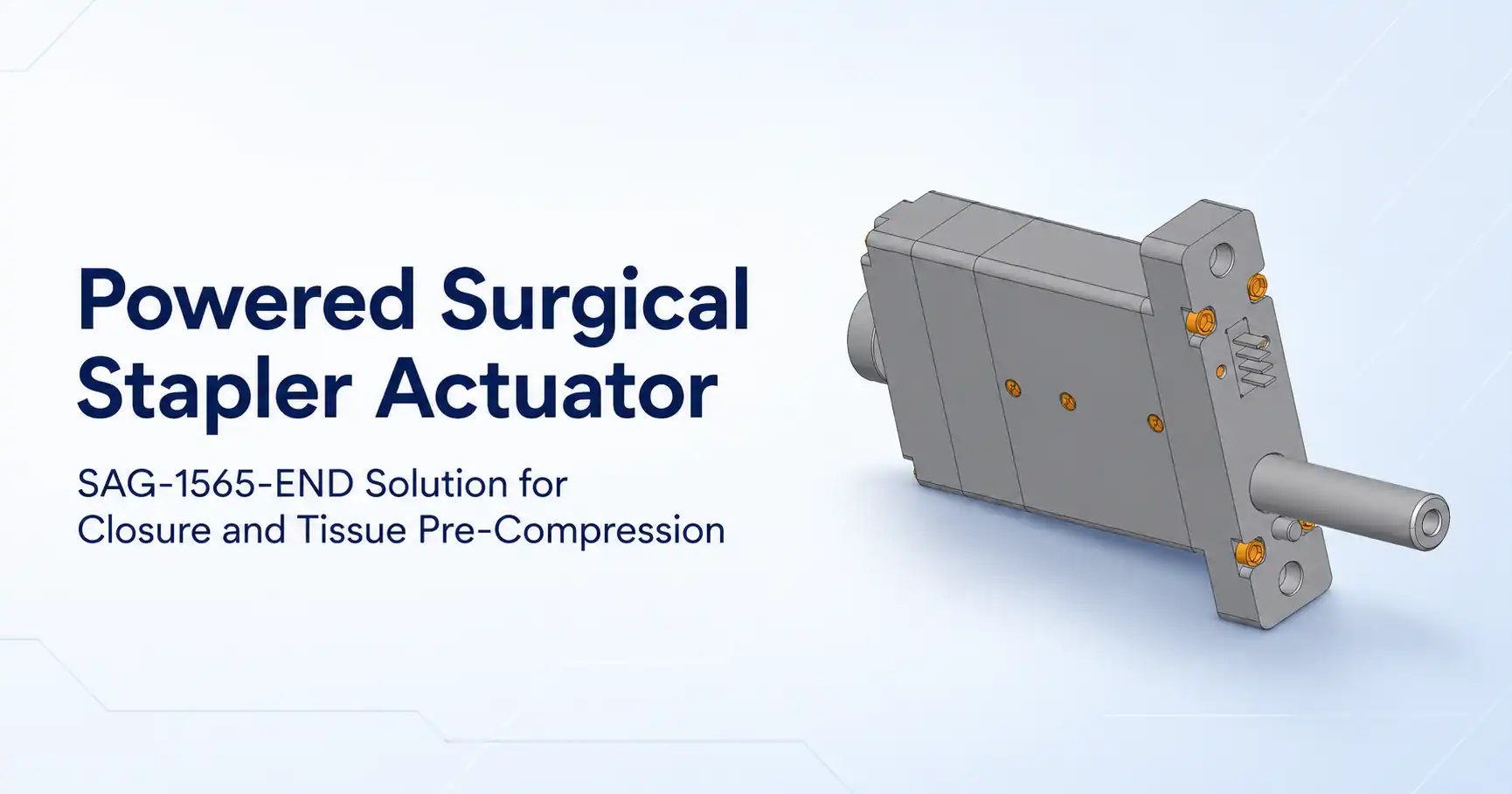
A powered surgical stapler must clamp and compress tissue, deploy staples, and, in some models, cut tissue simultaneously. As a critical motion component inside the device, the Powered Surgical Stapler Actuator must provide sufficient force while maintaining controlled speed, repeatable positioning, and reliable operation. It should also support manual operation if electrical power is unavailable.
Die SAG-1565-END is a high-force linear actuator integrating a coreless brushed DC motor, planetary gearbox, planetary roller screw, absolute position feedback, and RS485 communication. It provides a rated push/pull force of 300 N, a maximum push/pull force of 500 N, a 12 mm stroke, a no-load linear speed of 0.4 mm/s, and repeat positioning accuracy of ±3 μm.
If power is unavailable, the actuator can still be controlled manually using the handwheel at the bottom of the motor. This allows the rod position to be adjusted without electrical power.
With its short stroke, high force, precise position feedback, and manual override capability, the SAG-1565-END is suitable for powered surgical stapler jaw closure, tissue pre-compression, anvil positioning, and high-load linear motion inside robotic staplers.
As a manufacturer of DC gear motors and precision motion actuators, we can customize the motor, gearbox, roller screw, feedback system, output rod, mounting structure, and electrical interface according to the application requirements.
Auf einen Blick
Item Details Product SAG-1565-END High-Force Linear Actuator Drive System Coreless brushed DC motor, planetary gearbox and planetary roller screw Nennspannung 12 V Stroke 12 mm Rated Force 300 N push/pull Maximum Force 500 N push/pull No-Load Speed 0.4 mm/s Positioning ±3 μm repeat positioning accuracy Feedback Absolute position feedback with RS485 Manual Override Bottom handwheel for manual rod adjustment without power Best Suited For Stapler jaw closure, tissue pre-compression and anvil positioning Customization Stroke, force, speed, gearbox, output rod, feedback and mounting
Why Does a Powered Surgical Stapler Actuator Require Precise Control?
The operation of a powered surgical stapler usually involves three related but functionally different stages:
- Closing the jaws to hold the target tissue between the cartridge and anvil;
- Pre-compressing the tissue to stabilize its thickness and fluid distribution;
- Forming the staples and, depending on the stapler design, cutting the tissue.
Tissue thickness, density, and fluid content vary between applications. The resistance experienced during closure and firing is therefore not constant.
Insufficient compression may affect staple formation. Excessive closing speed or an unsuitable final tissue gap may increase the risk of tissue movement, uneven compression, or tissue damage.
For this reason, a Powered Surgical Stapler Motor should not be controlled using only basic start and stop signals. The complete actuation system should use position, current, time, or external force information to determine whether the jaws have closed correctly, whether the mechanism is obstructed, and whether the load has exceeded the specified limit.
For a powered stapler, the most important question is not simply how much maximum force the actuator can generate. The actuator must deliver controlled, repeatable, and verifiable force at the required position and speed.
Key Challenges for a Surgical Stapler Closure Actuator
A Surgical Stapler Closure Actuator may encounter different tissue thicknesses and mechanical properties during each operation. It must therefore provide force, position control, and fault management within a restricted installation space.
The main engineering challenges include:
- Variable closure resistance caused by different tissue thicknesses;
- Abnormal loads caused by incorrect cartridge installation;
- Mechanical obstruction caused by foreign objects inside the jaws;
- Insufficient tissue compression before firing;
- Motor, gearbox, or transmission stalling;
- Tissue remaining clamped after a loss of power;
- Safe stopping or release following a control-system fault.
The U.S. Food and Drug Administration recommends that surgical stapler instructions address the prevention and mitigation of jamming, locking, misfiring, and other malfunctions. The instructions should also identify the time required for adequate pre-firing compression.
FDA reference: The instructions should specify the time required for adequate pre-firing compression and provide procedures for preventing or mitigating jamming, locking, misfiring, and other malfunctions.
Source: FDA – Surgical Staplers and Staples for Internal Use
The FDA also notes that robotic staplers present the same main risks as other surgical staplers for internal use. Its relevant labeling recommendations therefore also apply to robotic staplers.
The FDA does not specify a particular motor type or require an actuator to produce exactly 300 N or 500 N. From an actuator-design perspective, the system-level requirements translate into position confirmation, load monitoring, motion control, fault detection, and a reliable release method.
Why Does a Tissue Compression Actuator Need a Short Stroke and High Force?
Stapler jaw closure, tissue pre-compression, and anvil approximation generally require a relatively short linear movement. However, the internal drive mechanism may still experience a considerable axial load.
A Tissue Compression Actuator may therefore require a combination of short stroke, high force, stable low-speed movement, and accurate position feedback.
The SAG-1565-END provides a rated push/pull force of 300 N and a maximum push/pull force of 500 N. These values refer to the axial force generated at the actuator rod. They do not mean that the same force is applied directly to the patient’s tissue.
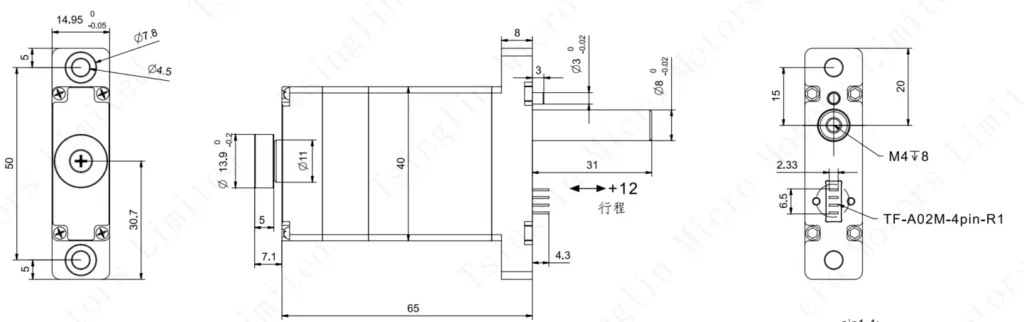
The final force at the stapler jaws depends on:
- Mechanical transmission ratio and efficiency;
- Jaw length and pivot position;
- Cam or linkage geometry;
- Internal friction;
- Jaw opening angle;
- Tissue position between the jaws.
Even when the actuator generates 300 N, the resulting jaw force may be higher or lower after passing through the stapler mechanism. The final tissue force should be calculated using the complete mechanical design and verified through system-level testing.
Some FDA 510(k) summaries include stapler firing-force tests among their non-clinical performance evaluations, together with pressure resistance, closed staple dimensions, and staple formation tests.FDA 510(k) stapler testing example
However, the FDA’s 2021 final classification order specifies the worst-case firing-force testing requirement primarily for manual staplers. For a powered stapler, the required actuator force should be determined from the actual transmission design, load curve, tissue range, and target compression performance.FDA 2021 final order
Planetary Roller Screw Actuator Design
The SAG-1565-END is a compact Planetary Roller Screw Actuator consisting of:
- A coreless brushed DC motor;
- A planetary gearbox;
- A planetary roller screw;
- A linear output rod;
- Absolute position feedback;
- An RS485 communication interface;
- A manual handwheel at the bottom of the motor.
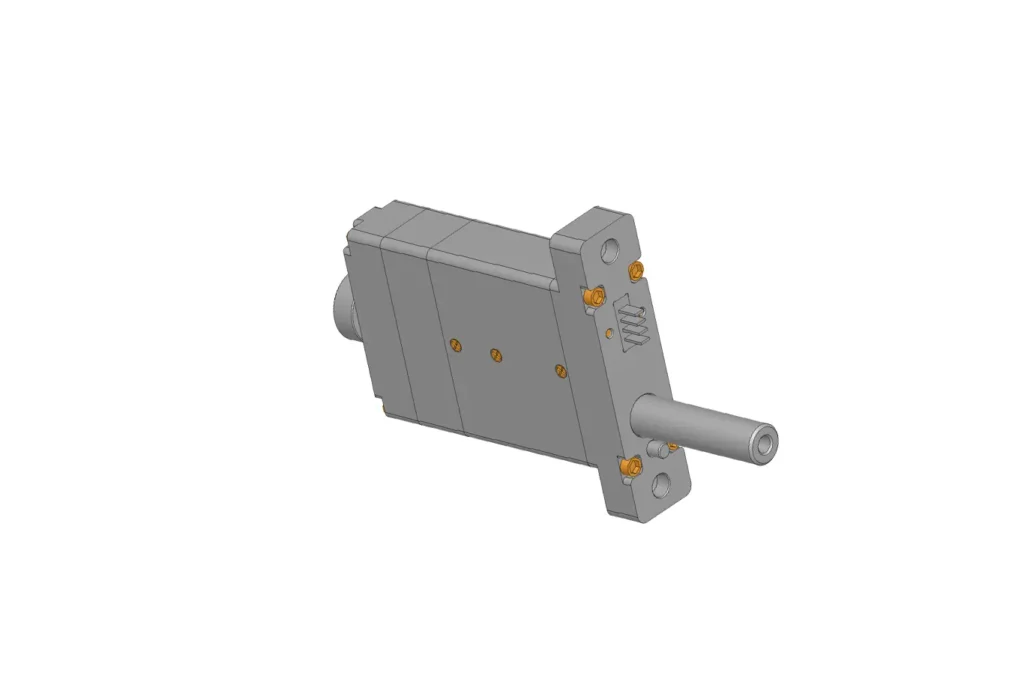
The coreless brushed motor generates rotary motion. The planetary gearbox reduces motor speed and increases torque. The planetary roller screw then converts the rotary motion into linear movement of the output rod.
A planetary roller screw uses multiple threaded rollers to transmit load. The increased number of load-bearing contact points supports high axial force within a compact mechanism. Additional information about the operating principle is available from Tolomatic’s planetary roller screw overview.
The SAG-1565-END uses absolute position feedback and RS485 communication. The controller can read the actuator position to determine whether the required closure travel has been completed. Motor current can also be monitored to help detect an abnormal load.
Position feedback confirms the actuator’s mechanical position, but it does not directly measure tissue compression force. The complete stapler should establish a verified relationship between actuator position, motor current, output force, tissue thickness, and final jaw gap.
Surgical Stapler Actuator With Manual Override
The SAG-1565-END is a Surgical Stapler Actuator with Manual Override.
If electrical power is unavailable, the operator can rotate the handwheel at the bottom of the motor. The handwheel mechanically drives the internal transmission and allows the output rod position to be adjusted manually.
The handwheel can support:
- Manual return after a power failure;
- Assisted release of clamped tissue;
- Manual adjustment following a mechanical obstruction;
- Position setting during assembly;
- Low-speed mechanical inspection during maintenance.
When the handwheel is used as part of an emergency-release function, the complete device design should verify:
- Handwheel accessibility after final installation;
- Clearly marked rotation direction;
- Required operating torque under load;
- Number of turns needed for full retraction;
- Time required to release the mechanism;
- Protection against accidental operation;
- Position-feedback consistency after manual adjustment.
The bottom handwheel provides a direct mechanical method of adjusting the actuator after a loss of power. Its release performance should be verified under the maximum expected system load.
Key Specifications of the 12V Linear Actuator for Powered Surgical Staplers
As a 12V Linear Actuator for Powered Surgical Staplers, the SAG-1565-END provides the following specifications:
| Parameter | Specification | Engineering significance |
|---|---|---|
| Nennspannung | 12 V | Suitable for a low-voltage DC drive system |
| Rated current | 800 mA | Rated operating-current parameter |
| Peak current | 2 A | Short-duration maximum-current parameter |
| Stroke | 12 mm | Suitable for short-stroke closure and positioning |
| Rated push/pull force | 300 N | Rated actuator output force |
| Maximum push/pull force | 500 N | Maximum short-duration force, not continuous rated force |
| No-load linear speed | 0.4 mm/s | Output speed without an external load |
| Repeat positioning accuracy | ±3 μm | Supports repeatable closure positioning |
| Feedback | Absolute position feedback | Reports the actuator position |
| Communication | RS485 | Enables communication with the main controller |
| Manual operation | Bottom handwheel | Allows manual rod adjustment without power |
Based on a 12 mm stroke and a no-load speed of 0.4 mm/s, the theoretical no-load full-stroke time is:
12 ÷ 0.4 = 30 seconds
This is a theoretical no-load value. It is not the operating time under a 300 N load. The actual travel time will also depend on the applied load, internal friction, supply voltage, acceleration profile, and control strategy.
Is the Actuator Better Suited to Closure or Complete Firing?
Based on its specifications, the SAG-1565-END is primarily suited to use as a Linear Actuator for Powered Surgical Stapler Closure, tissue pre-compression, and anvil positioning.
FDA product documentation shows that the cartridge and cutting travel of some linear staplers can be considerably longer than 12 mm. For example, one 60 mm reload produces an approximately 61 mm staple line and cuts tissue approximately 52 mm beyond the tissue stop.FDA K223760 product summary
If an actuator must directly move the knife and staple-driving components over more than 50 mm, a 12 mm actuator stroke will usually be insufficient. A lever, gear, rack, or other stroke-conversion mechanism would be required.
One powered stapler patent describes reducing the firing-assembly speed to approximately 2–5 mm/s over the final 5–15 mm of the firing stroke to limit end-of-stroke impact.Powered Surgical Stapler Speed Control Patent
This value applies only to the final-stage control method described in that patent. It is not a universal powered-stapler firing speed. The patent’s firing-assembly speed also cannot be compared directly with the SAG-1565-END rod speed without considering the transmission ratio.
The main potential applications of the SAG-1565-END include:
- Powered stapler jaw closure;
- Tissue pre-compression and holding;
- Anvil approximation;
- Short-stroke, high-load positioning;
- Firing assistance through a stroke-conversion mechanism.
Robotic Stapler Actuator Applications
Surgical robot end effectors include graspers, scissors, needle holders, energy instruments, and robotic staplers. Each type of instrument has different force and motion requirements.
One cable-driven surgical robot study evaluated a clamping-force estimation method over a 0–2 N detection range. This was the effective range of that specific experiment, not a universal force limit for all surgical robots.Surgical robot clamping-force study
Another insertable robotic end-effector study reported a maximum gripping force of approximately 40 N. That result also applies only to the specific mechanism tested in the study.Insertable robotic end-effector study
Tissue damage depends not only on force but also on gripping duration, jaw area, jaw-surface design, and tissue type. One laparoscopic grasping study evaluated forces of 10, 20, 40, 50, and 70 N over different time periods.Laparoscopic tissue-grasping study
The 300 N rated actuator force should therefore not be interpreted as a 300 N force applied directly to tissue. In a Robotic Stapler Actuator, the linear output is converted through the end-effector mechanism and controlled within a verified tissue-force range.
The SAG-1565-END can support the following functions inside a robotic stapler:
- Jaw closure;
- Anvil approximation;
- Tissue pre-compression;
- High-load mechanism positioning;
- Closure-position confirmation;
- Abnormal-load detection;
- Manual adjustment and assisted release after power loss.
Control Design for a Powered Surgical Stapler Tissue Compression Actuator
When the SAG-1565-END is used as a Powered Surgical Stapler Tissue Compression Actuator, the controller should manage more than the starting and ending positions.
Recommended monitoring parameters include:
- Actual actuator position;
- Motor current;
- Rod speed;
- Operating time;
- Difference between commanded and actual position;
- Abnormal current increase;
- Stall or obstruction status.
If the actuator has not reached its target position but the current rises quickly or the rod stops moving, the tissue may be too thick, the mechanism may be obstructed, the cartridge may be installed incorrectly, or a foreign object may be present.
Depending on the system risk analysis, the controller can stop, issue an alarm, maintain position, or reverse the actuator.
The control strategy should also consider:
- Multi-stage closure speed;
- Initial tissue-contact detection;
- Pre-compression holding time;
- Rated and peak current limits;
- Software and mechanical travel limits;
- Feedback-signal fault detection;
- Motor temperature rise and duty cycle;
- Manual handwheel procedures after power loss.
The FDA treats risk management as a process covering the full medical-device lifecycle and identifies ISO 14971 as a principal medical-device risk-management standard.FDA Risk Basics for Medical Devices
Medical Project Validation and Customization
Actuator specifications provide a basis for initial selection, but final performance should be verified in the complete medical device.
Recommended tests include:
- No-load and loaded-speed testing;
- Operation under the 300 N rated load;
- Short-duration testing at the 500 N maximum load;
- Force, current, speed, and displacement correlation;
- Closure testing with different tissue-simulating materials;
- Complete transmission-efficiency testing;
- Actual jaw-force measurement;
- Stall and overload-protection testing;
- Temperature-rise and duty-cycle testing;
- Repeat-positioning verification;
- Life and wear testing;
- RS485 communication-fault testing;
- Handwheel operating-torque testing;
- Manual release under maximum expected load;
- Manual return time and required number of turns;
- Position-feedback consistency after manual operation;
- Cleaning, disinfection, and sterilization compatibility assessment.
The actuator can be customized around different powered stapler requirements, including:
- Output stroke and speed;
- Rated and maximum force;
- Motor voltage and power;
- Planetary gear ratio;
- Roller screw lead;
- Output rod geometry;
- Mounting holes and housing dimensions;
- Position feedback and communication interface;
- Connector and wire configuration;
- Handwheel dimensions and orientation;
- External manual-control shaft;
- Controller and overload-protection logic.
Before customization, the project requirements should specify the target stroke, operating force, maximum load, speed, duty cycle, installation space, and transmission structure. If the handwheel will be used for emergency release, the project should also specify the maximum allowable operating torque, available access space, and target release time.
Fazit
The SAG-1565-END is a Powered Surgical Stapler Actuator designed for short-stroke, high-force linear motion. It integrates a coreless brushed DC motor, planetary gearbox, planetary roller screw, absolute position feedback, and RS485 communication.
The actuator provides a 12 mm stroke, a rated push/pull force of 300 N, a maximum push/pull force of 500 N, a no-load linear speed of 0.4 mm/s, and repeat positioning accuracy of ±3 μm.
If electrical power is unavailable, the operator can manually adjust the rod position using the handwheel at the bottom of the motor. This Surgical Stapler Actuator with Manual Override can support manual return, maintenance adjustment, and the mechanical release function of the complete device.
With its short stroke, high force, controlled low-speed movement, position feedback, and manual override, the SAG-1565-END is suitable for use as a Surgical Stapler Closure Actuator, Tissue Compression Actuator, und Robotic Stapler Actuator.
As a manufacturer of DC gear motors and precision actuators, we can customize the motor parameters, gear ratio, roller screw, output rod, connector, feedback system, and control solution according to the required force, stroke, speed, duty cycle, installation space, and manual-release requirements.
Frequently Asked Questions
1.What are the advantages of the SAG-1565-END Powered Surgical Stapler Actuator?
It combines a coreless DC motor, planetary gearbox, and roller screw, providing 300 N rated force, 500 N maximum force, and a compact 12 mm stroke.
2. Can it control tissue compression accurately?
Yes. Its 0.4 mm/s no-load speed, absolute position feedback, and RS485 interface support controlled closure and tissue pre-compression. Actual tissue force should be verified in the complete stapler system.
3. Can the actuator be operated after a power failure?
Yes. The bottom handwheel allows manual rod adjustment when power is unavailable, supporting manual return and emergency release.
4. Can it directly drive the complete stapler firing stroke?
It is better suited to jaw closure, tissue pre-compression, and anvil positioning. A stroke-conversion mechanism may be required for longer firing travel.