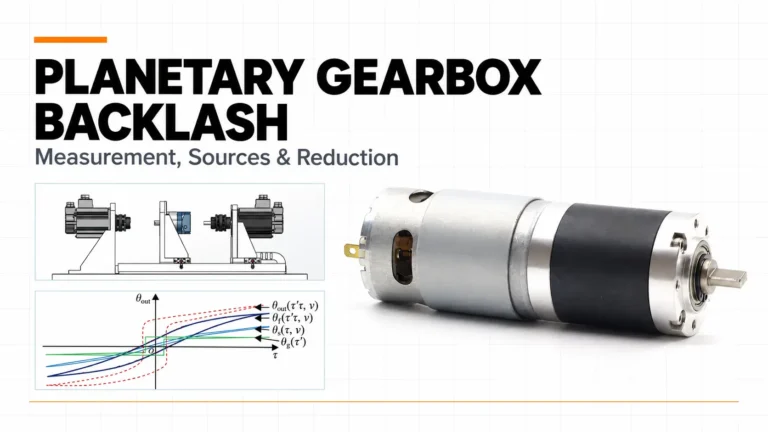
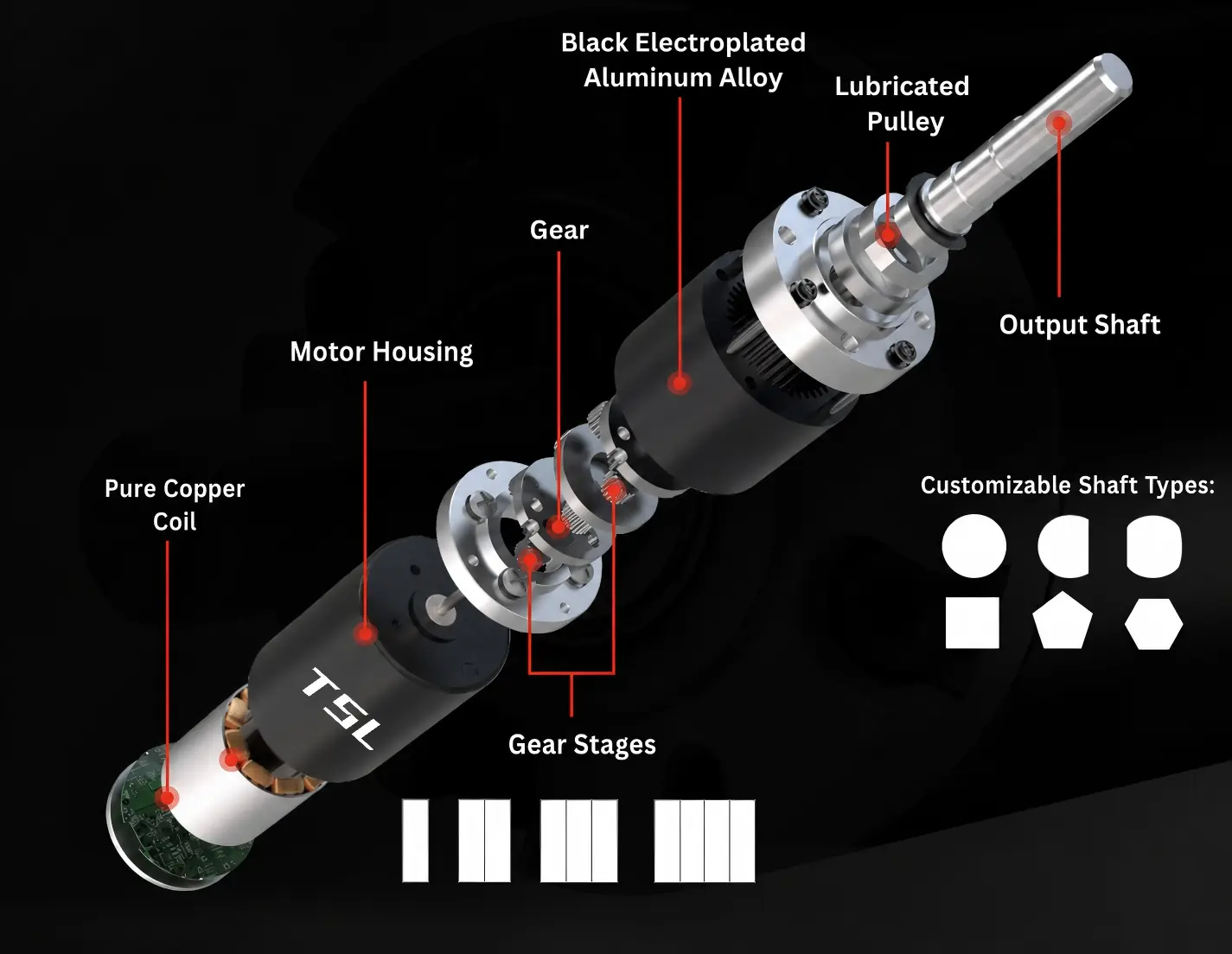
Ein bürstenloser Planetengetriebemotor ist ein Antriebsprodukt, das einen bürstenlosen Gleichstrommotor mit einem Planetengetriebe kombiniert.
Ein bürstenloser Motor läuft normalerweise mit hoher Geschwindigkeit. Das Planetengetriebe reduziert die Ausgangsdrehzahl und erhöht das Ausgangsdrehmoment. Zusammen sorgen sie für eine stabile Leistung bei kompaktem Bauraum. Sie werden häufig in Robotern, medizinischen Geräten, Automatisierungssystemen, intelligenten Schlössern, Präzisionsinstrumenten und anderen Produkten eingesetzt.
Bei der Auswahl eines bürstenlosen Planetengetriebemotors sollten Einkäufer und Fachingenieure in Forschung und Entwicklung nicht nur Spannung und Untersetzung berücksichtigen. Sie sollten auch Ausgangsdrehzahl, Drehmoment, Abmessungen, Betriebsdauer, Getriebespiel, Ansteuerungsmethode und Lebensdauer berücksichtigen.
Was ist ein bürstenloser Planetengetriebemotor?
Ein bürstenloser Planetengetriebemotor besteht normalerweise aus zwei Hauptteilen:
1. Bürstenloser Gleichstrommotor
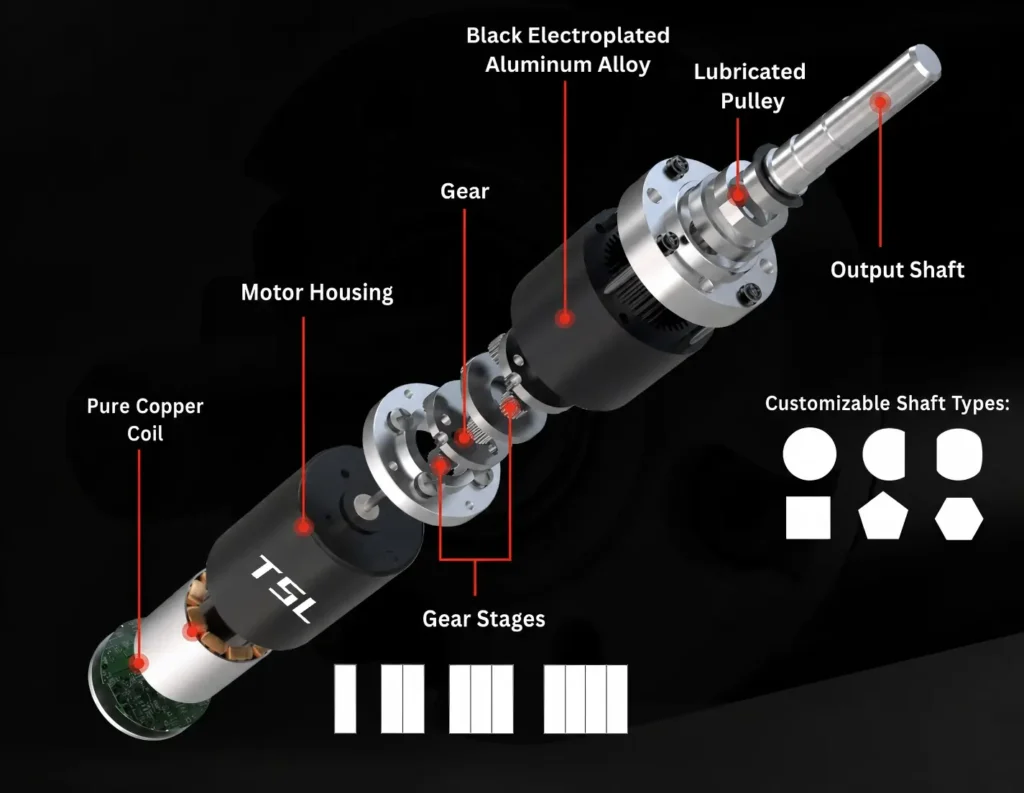
Der bürstenlose Gleichstrommotor sorgt für eine hochinnedrehende Rotation. Das Planetengetriebe reduziert die Drehzahl und wandelt die Motorleistung in ein höheres Ausgangsdrehmoment um.
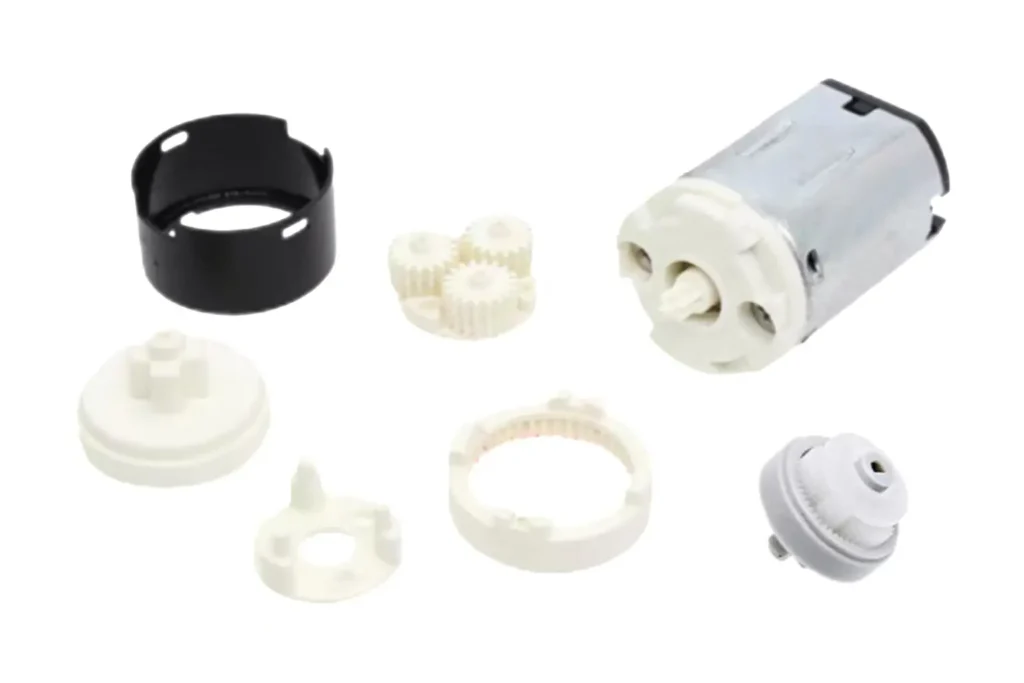
Ein Planetengetriebe umfasst normalerweise ein Sonnenrad, Planetenräder, ein Hohlrad und einen Planetenträger. Mehrere Planetenräder rotieren um das Sonnenrad und kämmen gleichzeitig mit dem Hohlrad.
Im Vergleich zu einer herkömmlichen einstufigen Getriebestruktur verteilt ein Planetengetriebe die Last auf mehrere Zahnräder. Daher kann es bei gleichem oder ähnlichem Außendurchmesser in der Regel ein höheres Drehmoment übertragen.
Warum einen bürstenlosen Motor wählen?
Konventionell gebürsteter Gleichstrommotor verwendet Kohlebürsten und einen Kommutator, um den Strom umzuschalten. Die Bürsten nutzen sich während des Betriebs allmählich ab. Lebensdauer und Wartung müssen daher berücksichtigt werden.

Ein bürstenloser Gleichstrommotor nutzt eine elektronische Kommutierung und hat keine mechanischen Kohlebürsten. Verglichen mit einem bürstenbehafteten Motor leistet er im Langzeitbetrieb, bei häufigen Start-Stopp-Zyklen und in der Drehzahlregelung normalerweise bessere Dienste.
Ein bürstenloser Motor eignet sich für folgende Betriebsbedingungen:
- Lange Betriebsdauer
- Häufiges Starten und Stoppen
- Anforderung an eine lange Lebensdauer
- Schwierige Wartung nach der Installation
- Geschwindigkeitsanpassung oder Geschwindigkeitsrückmeldung erforderlich
- Spezifische Anforderungen an das Betriebsgeräusch
- Vorwärts- und Rückwärtssteuerung erforderlich
Ein bürstenloser Motor benötigt normalerweise einen kompatiblen bürstenlosen Motortreiber.
Je nach Steuerungsanforderung kann das System Hall-Sensoren, sensorlose Regelung oder Geberrückführung nutzen.
Was sind die Vorteile eines Planetengetriebes?
Das Planetengetriebe ist ein Kernbestandteil eines bürstenlosen Planetengetriebemotors. Es beeinflusst direkt das Ausgangsdrehmoment, die Drehzahl, das Flankenspiel, die Geräuschentwicklung und die Lebensdauer.
Kompakte Größe und relativ hohes Drehmoment
Mehrere Planetenräder übertragen gleichzeitig Leistung und teilen sich die Last.
Wenn der Einbauraum begrenzt ist, kann eine Planetengetriebestruktur normalerweise ein höheres Abtriebsdrehmoment als eine herkömmliche Stirnradgetriebestruktur liefern.
Koaxiale An- und Abtriebswellen
Bei den meisten Planetengetrieben liegen die Antriebs- und die Abtriebswelle auf derselben Achslinie.
Diese Struktur lässt sich einfach installieren. Sie eignet sich besonders für zylindrische Räume, mechanische Verbindungen und enge Baugruppen.
Große Übersetzungsbandbreite
Ein Planetengetriebe kann verschiedene Stufenanzahlen nutzen, um unterschiedliche Übersetzungsverhältnisse zu erreichen.
Ein höheres Übersetzungsverhältnis verringert normalerweise die Ausgangsdrehzahl und erhöht das Ausgangsdrehmoment. Mehr Reduzierungsstufen können jedoch auch die Länge vergrößern, den Wirkungsgrad verringern und das Flankenspiel vergrößern.
Stabile Übertragung
Mehrere Planetenräder greifen gleichzeitig ineinander. Dadurch wird die Last gleichmäßiger verteilt.
Durch eine geeignete Konstruktion und Bearbeitungsgenauigkeit kann ein Planetengetriebemotor eine stabile Leistungsabgabe liefern.
Spiel kann kontrolliert werden, um die Anforderungen zu erfüllen
Verschiedene Anwendungen stellen unterschiedliche Anforderungen an das Umkehrspiel.
Standardgetriebe mit normalem Flankenspiel können in allgemeinen Getriebeanlagen eingesetzt werden. Robotergelenke, Präzisionspositioniermechanismen und Automatisierungsanlagen erfordern normalerweise ein geringeres Flankenspiel.
Bürstenloser Planetengetriebemotor im Vergleich zu anderen Getriebemotoren
Verschiedene Getriebemotoren weisen unterschiedliche strukturelle Eigenschaften auf. Bei der Auswahl sollten Einbaurichtung, Abtriebsdrehmoment, Steuerungsanforderungen, Kosten und Lebensdauer verglichen werden.
| Getriebemotortyp | Hauptmerkmale | Zu beachtende Punkte | Häufige Anwendungen |
| Bürstenloser Planetengetriebemotor | Kompakte Bauform, hohes Drehmoment, lange Lebensdauer | Erfordert einen bürstenlosen Treiber | Roboter, medizinische Geräte, Automatisierungsgeräte |
| Gebürsteter Planetengetriebemotor | Einfache Steuerung und relativ geringe Kosten | Kohlebürsten nutzen sich allmählich ab | Verbrauchsgüter und Geräte für den Kurzzeitbetrieb |
| Bürstenloser Stirnradmotor | Einfache Bauweise und flexible Übersetzungsoptionen | Kann bei gleichem Drehmoment größer sein | Bürogeräte und Verkaufsautomaten |
| Bürstenloser Schneckengetriebemotor | Bietet einen rechtwinkligen Ausgang | Normalerweise weniger effizient als ein Planetengetriebe | Ventile, Schlösser und Einstellmechanismen |
| Schrittmotor mit Planetengetriebe | Komfortable Lageverstellung | Hohe Geschwindigkeit und ein reibungsloser Betrieb müssen berücksichtigt werden | Positioniertische und Dosiergeräte |
Wenn ein Produkt eine kompakte Bauweise, ein hohes Drehmoment, eine Drehzahlregelung und eine lange Lebensdauer erfordert, ist ein bürstenloser Planetengetriebemotor in der Regel eine geeignete Wahl.
Wie klein kann ein bürstenloser Planetengetriebemotor sein?
Die Motorengröße ist oft ein entscheidender Designfaktor in medizinischen Geräten, Miniaturrobotern, geschickten Händen, Laborgeräten und tragbaren Produkten.
TSL MOTOR bietet eine Reihe von Miniatur-Bürstenlosen-Getriebemotoren-Lösungen an. Der kleinste bürstenlose eisenlose Getriebemotor kann einen Durchmesser von nur 8 mm haben.
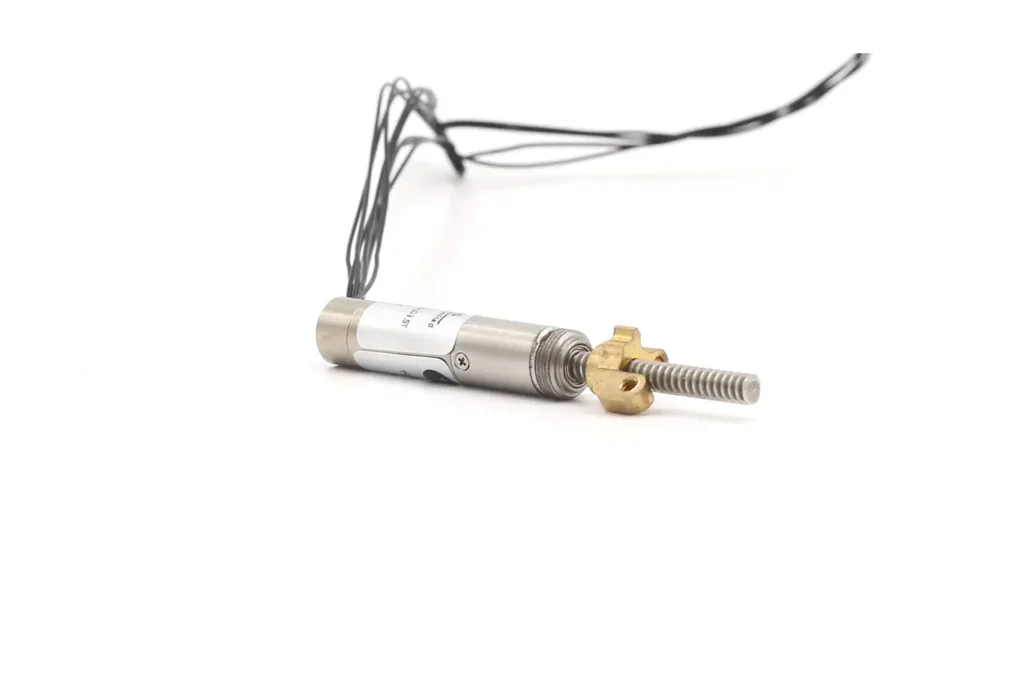
Diese Art von Produkt kombiniert normalerweise einen bürstenlosen eisenlosen Motor mit einem Miniatur-Planetengetriebe.
Die folgenden Optionen können je nach Kundenwunsch ebenfalls hinzugefügt werden:
- Hallsensoren
- Magnetischer oder optischer Encoder
- Integrierter Treiber
- Kundenspezifische Abtriebswelle
- Spindeltrieb
- Benutzerdefinierter Verbinder
- Benutzerdefinierte Drahtlänge
- Spezielle Übersetzung
- Erforderliche IP-Schutzart
An 8 mm brushless coreless gear motor is suitable for products with very limited installation space and specific requirements for weight, response speed, and control performance.
A coreless motor has no conventional iron-core structure. Its rotor inertia is low, so it normally responds faster during starting, stopping, and reversing.
Häufige Anwendungsbereiche eines bürstenlosen Planetengetriebemotors
Robots and Dexterous Hands
Robot joints, grippers, manipulators, and dexterous hands normally require a compact and lightweight drive with sufficient output torque.
A brushless planetary gear motor increases torque through the planetary gearbox. An encoder can provide speed or position feedback.
Medical Equipment
Medical equipment often has specific requirements for motor size, noise, stability, and service life.
- Common applications include:
- Surgical instruments
- Rehabilitation equipment
- Infusion equipment
- Laboratory analysers
- Small pumps and valves
Medical Robots
When selecting a motor for medical equipment, temperature rise, noise, materials, operating environment, and service life should also be considered carefully.
Automatisierungsausrüstung
In automation equipment, a brushless planetary gear motor can be used for:
- Electric grippers
- Small conveyor mechanisms
- Positioning mechanisms
- Valve actuators
- Automatic adjustment mechanisms
- Small pumps
- Robotic end effectors
For precise control, an encoder and a closed-loop driver can be added.
Smart Locks and Door-Control Equipment
Smart door locks, cabinet locks, and door-control equipment normally require a compact installation size and sufficient starting torque.
Friction inside the lock body may vary. A suitable torque margin should therefore be reserved during selection.
Pumps and Fluid-Control Equipment
Miniature pumps, metering pumps, and valve actuators require stable speed and reliable starting performance.
A suitable gear ratio can adjust the motor output speed to match the requirements of the pump or valve mechanism.
Optical Equipment and Laboratory Instruments
Microscopes, spectrometers, pipetting equipment, and sample-handling equipment normally require smooth and repeatable motion.
A brushless coreless motor combined with a planetary gearbox and encoder can drive these precision motion mechanisms.
Auswahl eines bürstenlosen Planetengetriebemotors
When selecting a brushless planetary gear motor, start with the load and actual operating conditions. Do not begin by choosing a motor model directly.
Ausgangsdrehmoment bestimmen
First, calculate the torque required during normal equipment operation.
In addition to the rated operating torque, consider:
- Starting torque
- Acceleration torque
- Instantaneous peak torque
- Friction resistance
- Load during jamming or stalling
- Torque caused by external impact
Do not select the motor based only on stall torque.
For long-term operation, the motor should run within its rated operating range with a suitable safety margin.
Ausgabegeschwindigkeit ermitteln
The relationship between motor speed and gear ratio can be estimated with the following formula:
Output speed = Motor speed ÷ Gear ratio
For example, if the motor speed is 10,000 rpm and the gearbox ratio is 100:1, the output speed is approximately 100 rpm.
Wählen Sie ein geeignetes Übersetzungsverhältnis
A higher gear ratio normally reduces speed and increases torque.
However, a higher gear ratio is not always better.
An excessively high gear ratio may cause the following problems:
- Longer gearbox
- More reduction stages
- Lower transmission efficiency
- More backlash
- Output speed that is too low
- Higher cost
A practical approach is to run the motor at a suitable operating speed and use the gearbox to achieve the required output speed.
Bestätigen Sie die Betriebsspannung und den Treiber
Common voltage options include:
- 6 V
- 12 V
- 24 V
- Other custom voltages
The brushless driver must match the motor voltage, current, Hall configuration, and control method.
Confirm the following during selection:
- Supply voltage
- Maximum operating current
- Forward and reverse control
- PWM speed control
- Hall signals
- Encoder interface
- Speed-control or position-control method
Einbaumaße bestätigen
Confirm the following dimensions in advance:
- Motor outer diameter
- Gearbox outer diameter
- Overall length
- Output shaft diameter
- Abtriebswellenlänge
- Mounting-hole positions
- Connector dimensions
- Wire outlet direction
For miniature equipment, a difference of only a few millimetres may affect the final installation.
Bestätigen Sie die Betriebszeit und das Lastspiel
Different duty cycles have a major effect on motor temperature rise and service life.
For example, a motor that runs for only 5 seconds per minute has very different power and heat-dissipation requirements from a motor that runs continuously.
Provide the following information to the supplier:
- Running time per cycle
- Stop time per cycle
- Number of starts and stops per hour
- Whether continuous operation is required
- Ambient operating temperature
- Load variation
- Expected service life
Spiel und Positioniergenauigkeit bestätigen
For pumps, fans, or general transmission mechanisms, the backlash requirement is normally not very strict.
For robot joints, positioning stages, or precision actuators, confirm:
- Maximum allowable backlash
- Repeat positioning accuracy
- Encoder resolution
- Forward and reverse switching frequency
- Whether closed-loop control is required
An encoder can measure motor position or speed. However, it cannot directly eliminate mechanical backlash inside the gearbox.
For systems with high positioning-accuracy requirements, both the gearbox structure and control compensation should be considered.
Bestätigen Sie die Lärmschutzanforderungen
Motor noise depends on the motor structure and the following factors:
- Gear material
- Gear machining accuracy
- Number of reduction stages
- Motor speed
- Output load
- Bearing structure
- Lubricating grease
- Housing resonance
- Mounting method
If the project has a clear noise limit, provide the actual operating speed, load, and mounting method for a targeted evaluation.
Welche Informationen werden für die Anfrage eines bürstenlosen Planetengetriebemotors benötigt?
To receive a suitable motor recommendation more quickly, provide the following information with your enquiry:
- Product application
- Betriebsspannung
- Motor no-load speed
- Continuous operating torque
- Peak torque
- Maximum allowable diameter
- Maximum allowable length
- Duty cycle
- Output shaft dimensions
- Whether Hall sensors are required
- Whether an encoder is required
- Whether a driver is required
- * Wire length and connector requirements
- Sample quantity
- Estimated annual quantity
The more complete the information is, the easier it is for the supplier to determine whether the motor, gearbox, and driver are suitable for the application.
Welche Anpassungsdienste für bürstenlose Planetengetriebemotoren bietet TSL MOTOR an?
TSL MOTOR provides custom brushless planetary gear motor solutions based on the customer’s product structure and operating requirements.
Customisable items include:
- Motor diameter
- Motor length
- Betriebsspannung
- Motor winding
- Übersetzungsverhältnis
- Output speed
- Output torque
- Gear material
- Output shaft dimensions
- Output shaft shape
- Bearing structure
- Lubrication method
- Hall configuration
- * Encoder type
- Encoder resolution
- Integrierter Treiber
- Wire length
- Connector
- Backlash
- Lärm
- Service life
For products with limited installation space, we can also provide brushless coreless gear motor solutions with diameters as small as 8 mm.
After sample testing, the speed, torque, gear ratio, output shaft, and feedback system can be adjusted further.
Zusammenfassung
A brushless planetary gear motor is suitable for products that require compact size, high torque, adjustable speed, and long service life.
Motor selection should not consider only voltage, speed, or gear ratio. Output torque, duty cycle, temperature rise, backlash, driver, installation space, and service life should also be evaluated.
For robots, medical equipment, precision instruments, and compact automation equipment, a miniature brushless planetary gear motor can provide stable power in a limited space.
TSL MOTOR offers a wide range of custom brushless planetary gear motor and brushless coreless gear motor solutions. The smallest brushless coreless gear motor can have a diameter of only 8 mm.
For product selection, provide the voltage, speed, torque, dimensions, and application details. This helps us recommend a more suitable motor solution.
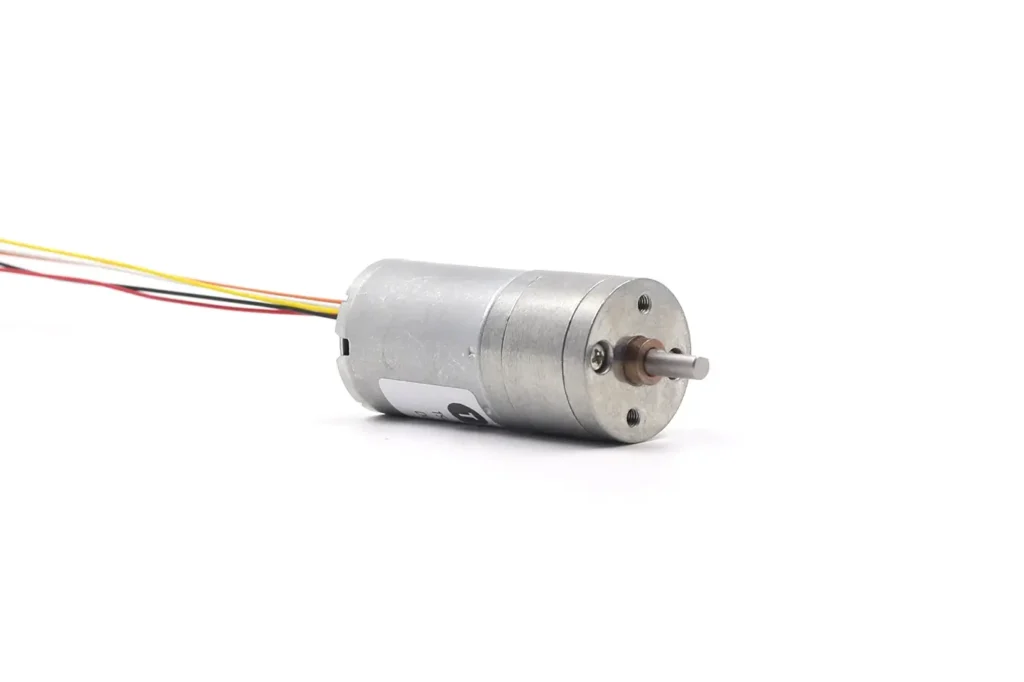
bürstenloser getriebemotor
Ein bürstenloser Getriebemotor ist eine ausgezeichnete Wahl für Geräte, die eine langlebige Leistung erfordern. Diese Motoren, gepaart mit Stirnrad-, Planeten- oder Schneckengetrieben, werden von führenden Herstellern von Miniatur-Getriebemotoren angeboten. Als bürstenlose Getriebemotoren bieten sie aufgrund des Fehlens von Bürsten im Gleichstrommotor eine längere Lebensdauer und geringere Wartungskosten.